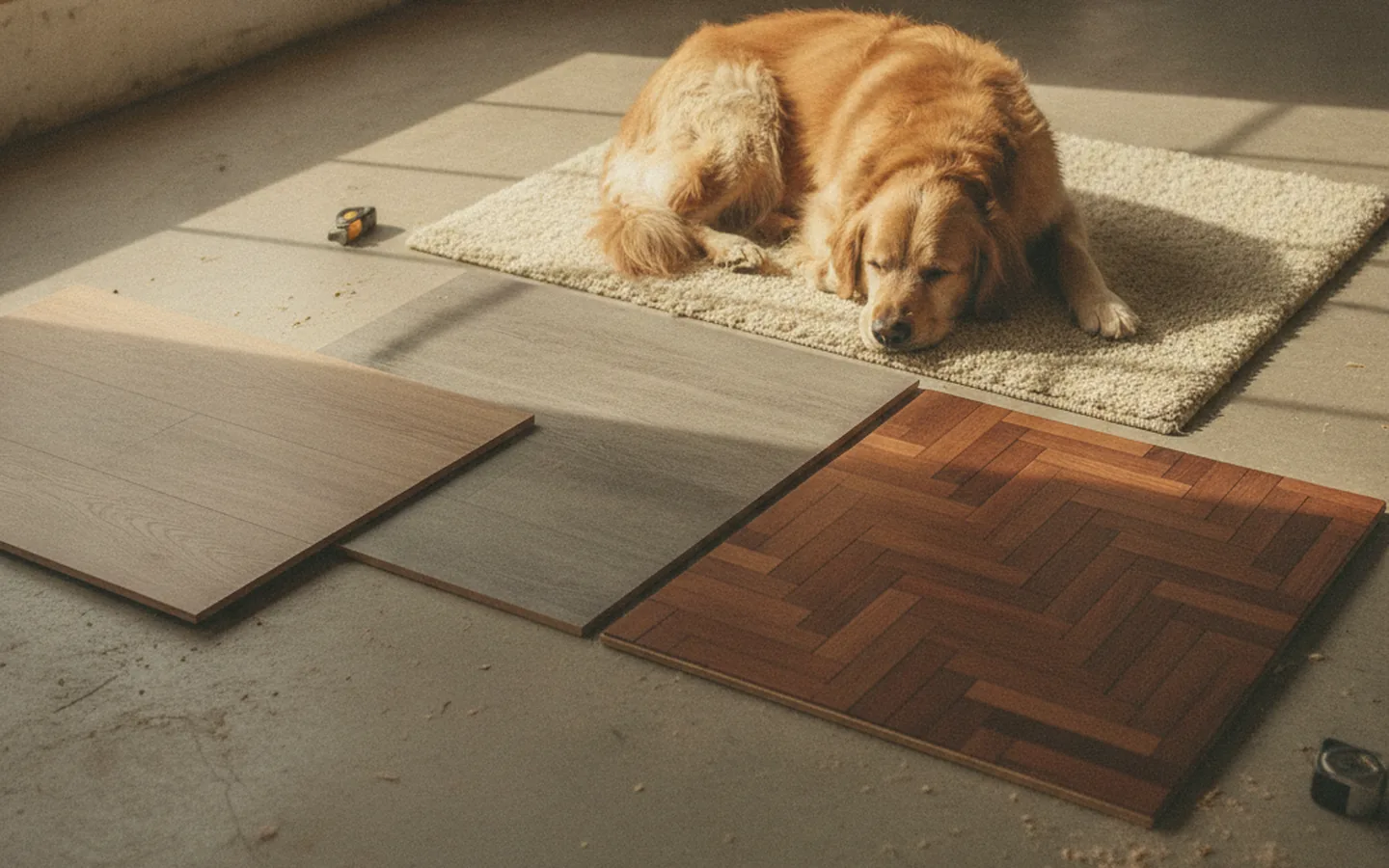
A floor in a family apartment lives a hard life. Toy cars and scooters roll over it, cups get dropped on it, markers get drawn on it, and a dog sprints to the door every evening with claws extended. That’s why choosing a material from a catalog photo alone is risky: a year later a beautiful floor can end up covered in scratches and bulging seams. Let’s break down the four most popular options and see how they behave in real everyday use.
What matters most to a family
Before comparing materials, it’s worth agreeing on the criteria. For an apartment with kids and pets, five things usually matter, and how much weight you give each depends on your situation.
- Resistance to scratches and impacts. Claws, toys, chair legs, casters.
- Water resistance. Spilled drinks, wet paws after a walk, kids’ “accidents,” a water bowl.
- Warmth and softness. Young children spend a lot of time on the floor.
- Noise. Footsteps and dropped objects are heard by the downstairs neighbors, and clicking claws get on your own nerves too.
- Ease of upkeep and repair. Whether you can replace a single board or sand out damage.
Four flooring options in practice
Below is a short rundown of each material: how it’s built, what it holds up to, and where its weak points are. The ratings assume a typical heated city apartment with preschool- and school-age children and one dog or cat.
Laminate
Laminate remains the most common choice thanks to its price and huge range of designs. For a family, go with a high wear-resistance class (33 and 34) with good edge protection against moisture. The top wear layer holds up reasonably well against everyday scratches, but a hard impact from a heavy object leaves a chip that almost never heals.
Laminate’s main weak point: the locks and edges. If water sits on a seam for a long time, the board swells, and it shows immediately. Water-resistant collections handle this noticeably better, but they still don’t like puddles. Also, laminate on a rigid base is fairly resonant, so underlayment and soundproofing are essential.
Luxury vinyl tile
Luxury vinyl tile or planks have become laminate’s main competitor in recent years. It’s a composite based on mineral filler and PVC with a wear layer on top. The material isn’t afraid of water, so it’s used in kitchens, entryways and even bathrooms. It’s quieter than laminate, warmer to the touch than tile, and holds up well to kids’ play.
There are nuances. Glue-down vinyl requires a perfectly flat subfloor: any unevenness in the screed will eventually show through on the surface. Click-lock versions are easier to install but are also sensitive to unevenness. Thin, cheap products can dent under heavy furniture legs, so look at the thickness of the wear layer, not just the overall thickness.
Hardwood and engineered flooring
Natural wood gives a warmth and coziness that no imitation can match. It’s important to understand that oak and other hardwoods are still softer than claws and metal toys. Scratches will appear; the only question is how you feel about them. The good news: a wood floor can be sanded and refinished, meaning it’s repairable.
For a family, an oiled finish works better than a glossy lacquer. Oil is easier to touch up locally, and wear marks on a matte surface look natural. Wood tolerates constant moisture and dry winter air poorly, so apartments with central heating need a humidifier.
Tile and porcelain tile
A note on grout lines. Grout in an entryway or kitchen darkens over time, especially light-colored grout. Epoxy grout costs more than cement-based grout but barely absorbs dirt and is easier to clean, so it pays off in a family apartment.
Porcelain tile is nearly indestructible: it shrugs off water, claws and wheels without a mark. It’s easy to clean, doesn’t absorb odors, and suits entryways, kitchens and bathrooms. For living rooms it has two downsides: it’s cold and hard. A dropped cup will definitely shatter, and a toddler learning to walk falls onto a hard surface. The cold is solved with underfloor heating, and the hardness can be softened with a rug in the play area.
There’s no perfect floor for a family, but there is flooring that forgives mistakes: spilled water, a dropped toy, and a dog’s claws on a turn.
Comparison in one table
The ratings below use a five-point scale for typical conditions in a family apartment. Prices are approximate, for 2026, per square meter of mid-range material including installation, without subfloor preparation.
| Material | Scratches and impacts | Moisture | Warmth and noise | Repair | Price with installation, ₽/m² |
|---|---|---|---|---|---|
| Class 33–34 laminate | 4 | 2-3 | 3 | board replacement | 1,300–3,500 |
| Luxury vinyl tile | 4 | 5 | 4 | plank replacement | 1,500–4,500 |
| Hardwood, engineered flooring | 2-3 | 2 | 5 | sanding | 4,500–12,000 |
| Porcelain tile | 5 | 5 | 1-2 | tile replacement | 2,500–6,500 |
How to combine materials by zone
Often the best solution isn’t a single material throughout the apartment, but sensible zoning. Wet and dirty zones get the most resilient material, while living rooms stay warm and quiet.
- Entryway: porcelain tile or luxury vinyl tile, so you can calmly greet wet paws and street shoes.
- Kitchen: luxury vinyl tile or porcelain tile, especially if the family has small children and something is always getting spilled.
- Living room and kids’ room: luxury vinyl tile, quality laminate, or oiled engineered flooring, with a washable rug in the play area.
- Bedroom: any warm flooring, since the load here is minimal.
When joining different materials, plan the floor level in advance so you don’t end up with thresholds that children trip over. This is handled by the thickness of the screed or underlayment during the rough-in stage.
The subfloor matters more than it seems
Any flooring only performs as well as the subfloor underneath it is flat. Uneven screed causes creaking and gaps at laminate locks, telegraphing bumps with glue-down vinyl, and cracks in tile. Before comparing prices on the material itself, have a professional check the floor with a two-meter level. If the deviation is more than a couple of millimeters over two meters, budget for leveling: roughly, for 2026, from 600 to 1,500 rubles per square meter depending on the layer thickness.
How long the flooring will last
With normal care, quality laminate and luxury vinyl tile last 10–20 years, tile and porcelain tile can outlive several renovations, and a wood floor with periodic sanding lasts for decades. In practice, flooring is more often replaced not because it’s worn out, but because the color got old or the layout changed. So it’s not worth overpaying for durability you won’t use, but it’s also not worth skimping on the wear layer in the entryway and kids’ room.
Caring for the floor in a home with pets is easier if you buy mats for the entryway and under food bowls, furniture leg pads, and trim your pet’s claws regularly. These small things extend the life of any flooring more than the difference between neighboring wear-resistance classes.
Practical tips before you buy
- Take samples home and scratch them with a key, spill water on them, leave them for a day. Five minutes of testing will tell you more than any advertising.
- Light and medium tones with a wood grain pattern hide dust, fur and scratches better than dark glossy finishes.
- Choose the underlayment based on the flooring manufacturer’s recommendation, or you risk voiding the warranty.
- Buy one or two packs more than your calculation: in a couple of years it will be hard to find the same batch to replace a damaged board.
- Factor in underfloor heating: not every flooring and not every underlayment is compatible with it.
Bottom line
If you need a single universal answer, quality luxury vinyl tile is the optimal choice today for most families with kids and pets: it’s quiet, water-resistant and forgiving of everyday mishaps. High-class laminate works if the budget is limited and there’s no constant moisture at home. Wood is chosen by those who value natural materials and warmth and aren’t bothered by the marks of daily life on the floor. Porcelain tile is great where water and dirt are unavoidable.
FAQ
Which flooring best withstands a dog’s claws?
Porcelain tile is practically scratch-proof, and among warmer options luxury vinyl tile with a thick wear layer and class 33–34 laminate hold up well. A matte finish helps hide small marks.
Can you put laminate in the kitchen in a family with small children?
Yes, water-resistant laminate with sealed locking joints works, but spills need to be wiped up right away. If water ends up on the floor often, luxury vinyl tile or porcelain tile is a safer choice.
Is hardwood suitable for an apartment with children?
It is, if you are ready to accept scratches as part of the floor’s character. An oiled finish is easier to touch up, and a badly worn wood floor can be sanded down.
This article is for informational purposes only and does not replace professional advice. Prices are approximate and current as of the review date. Found an error? Let the editors know via the contact page.