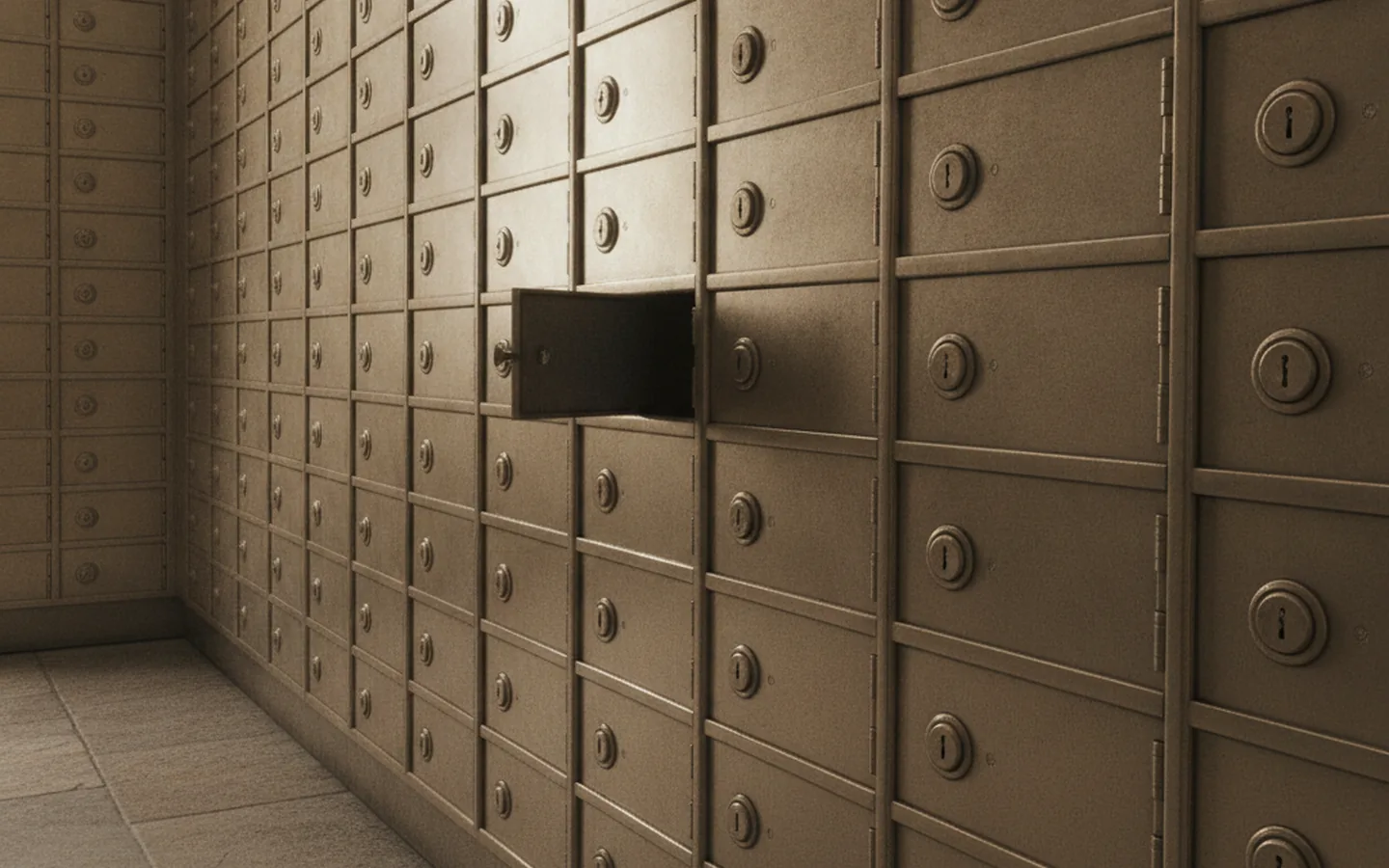
Grandma’s jewelry, the original deeds to an apartment, cash savings, a coin collection, or a hard drive with the family archive. Many people keep things at home whose loss no amount of money or insurance can make up for. A home safe protects against a casual thief, but not against fire, flooding, or a burglar who simply carries off the whole safe. That’s why more and more people are renting a safe deposit box: at a bank or at a specialized private storage facility.
Let’s look at what a safe deposit box actually gives you, how much it costs, what its limitations are, and who really needs one.
How box rental works
A safe deposit box is a metal box inside a guarded vault. You sign a rental agreement for a set term, get a key (sometimes together with a code or biometrics), and at any time during business hours you can come in, open the box in a private room, and put in or take out items. Staff don’t know what’s inside and don’t make an inventory unless you specifically ask them to.
This is the key difference from a deposit account. The bank is responsible for the physical security of the box and access to it, not for its specific contents. The deposit insurance system doesn’t cover safe deposit boxes: if something happens to the vault, you’ll have to prove and claim compensation separately, based on the terms of the contract.
Bank, private storage, or home safe
| Criterion | Home safe | Bank safe deposit box | Private storage facility |
|---|---|---|---|
| Access | 24/7 | During branch business hours | Often extended or 24/7 |
| Theft protection | Depends on the safe’s rating and how it’s anchored | High | High |
| Fire and water protection | Only on special models | High | High |
| Privacy | Complete, but household members know | Contents are not itemized | Contents are not itemized |
| Approximate cost | 10,000–60,000 ₽ one-time | 1,500–6,000 ₽ a month | 2,500–10,000 ₽ a month |
Prices are approximate, for 2026, for major cities. The cost depends on the box size and the rental term: a yearly rental is usually noticeably cheaper than paying month to month. In smaller cities, bank boxes are cheaper, but the choice of branches with a vault is much more limited.
A safe deposit box protects against theft and fire, but not against your own carelessness: if nobody knows about it, its contents can sit there unclaimed for years after you’re gone.
What makes sense to keep in a box
- Original documents: property title deeds and purchase agreements, a will or a copy of it, inheritance paperwork, birth and marriage certificates.
- Jewelry and watches you don’t wear every day.
- Cash savings, especially in foreign currency, if you hold any.
- Investment coins and bullion.
- A backup of the family archive and important files on an encrypted drive.
- Recovery codes for important accounts, written down on paper.
Don’t keep things in the box that you might suddenly need outside business hours: your passport before an early flight, medical records, spare house keys. A good home safe is a better fit for those.
Access, power of attorney and inheritance
One common mistake: the box is rented by a single person, and no one else in the family can get into it. If the renter gets sick, leaves for a long time, or dies, the contents become inaccessible. There are a few ways to avoid this.
- Set up access rights for a second person at the bank, if the contract allows it.
- Issue a notarized power of attorney for box access to a trusted relative.
- Tell your family which bank the box is at and where the key is kept, but don’t store the key together with the rental paperwork.
- Mention the box and its contents in your will or in a letter to your heirs.
After the renter’s death, heirs get access through a notary: the bank typically opens the box in the notary’s presence, draws up an inventory, and then the items are distributed as part of the inheritance case. The process takes time, so without arrangements made in advance, valuables can remain inaccessible for several months.
A box for settling a real estate deal
In Russia, a box is often rented not for storage but for a secure payment during an apartment purchase. The buyer deposits the money, and the seller only gets access after the transfer of ownership is registered and the required documents have been presented. The access terms are spelled out in a three-way contract with the bank.
A box like this costs roughly 3,000–10,000 ₽ for the duration of the deal, plus the bank may charge for checking and counting the bills. These days many deals go through a letter of credit or a bank’s cashless escrow service, which is often more convenient. A box is chosen when the payment is in cash or the parties are simply used to it.
How to use a box safely
How secure the vault is matters little if the owner breaks simple rules. Most unpleasant stories about safe deposit boxes aren’t about break-ins but about lost keys, missed payments, and disputes between relatives.
- Make yourself an inventory of the contents with photos and keep it separate from the box, for example, encrypted in the cloud.
- Don’t keep the only copy of a document you might suddenly need in the box: make a certified copy to keep at home.
- Pack documents in airtight bags, and electronics and storage media in anti-static sleeves: vaults are dry, but the extra precaution is cheap.
- Don’t tell outsiders you have a box and don’t discuss its contents in messaging apps.
- Once a year, come in and check that everything’s in place and the documents are still current.
If you keep cash in the box, remember that money sitting there earns nothing and gradually loses purchasing power to inflation. A box is good for a reserve that needs to be physically on hand, but it doesn’t replace a deposit account or other savings tools. It’s sensible to keep only as much cash there as you’d need for an emergency, and allocate the rest so it actually works for you.
Insuring the contents
Since the bank isn’t fully liable for the contents, it makes sense to insure especially valuable items separately. Some insurers offer policies specifically for valuables in safe deposit boxes, while others fold them into a home contents policy. This usually requires an appraised inventory and photos. Weigh the cost of the policy against the value of the items: for jewelry worth several hundred thousand rubles it’s worth it, for a stack of documents it isn’t.
Before taking out a policy, check whether it covers theft from the vault, fire, and flooding, and how the value of items will be determined when paying out a claim. For jewelry and coins, insurers usually ask for receipts or an appraiser’s report, so it’s worth keeping those documents too, ideally as copies at home and in the cloud.
How to choose a bank or storage facility
Before signing the contract, ask to see the vault and the room where you’d access the box. How the entrance is set up, who accompanies the client, and whether there’s a private room without cameras over the table already tells you a lot before you pay anything.
- The organization’s stability: a box is tied to a specific branch, and if that office closes, the contents will have to be moved.
- Convenience of the location and the vault’s business hours, not the branch’s in general.
- Liability terms and the box-opening procedure in the contract.
- Whether a second person can get access, and the process for setting up a power of attorney.
- The cost of renewal and penalties for late payment.
Be sure to track the rental term. Under the contract, if you don’t pay, the bank can open the box for a fee and move the contents into storage, then charge for that storage. Set up autopay or a reminder a month before the term ends.
A safe deposit box doesn’t replace common sense, but it does a good job of storing things you can’t afford to lose. A small monthly fee is usually nothing compared to the cost of losing your apartment deeds or family jewelry, and an arrangement with your family about access is what makes this storage method genuinely reliable.
FAQ
Are items in a bank safe deposit box insured, like deposits?
No. The deposit insurance system does not cover safe deposit boxes. The bank’s liability is defined by the contract and is often limited, so it makes sense to insure valuable items with a separate policy.
Can someone other than me open the box?
Yes, if you’ve set up access rights for a second person under the contract or issued a notarized power of attorney. Without that, after the renter’s death, heirs can only get access through a notary.
What happens if I forget to pay the rent?
The bank will start charging a late fee, and after the period specified in the contract, it may open the box for a fee and move the contents into storage. Set up autopay or a reminder in advance.
This article is for informational purposes only and does not replace professional advice. Prices are approximate and current as of the review date. Found an error? Let the editors know via the contact page.