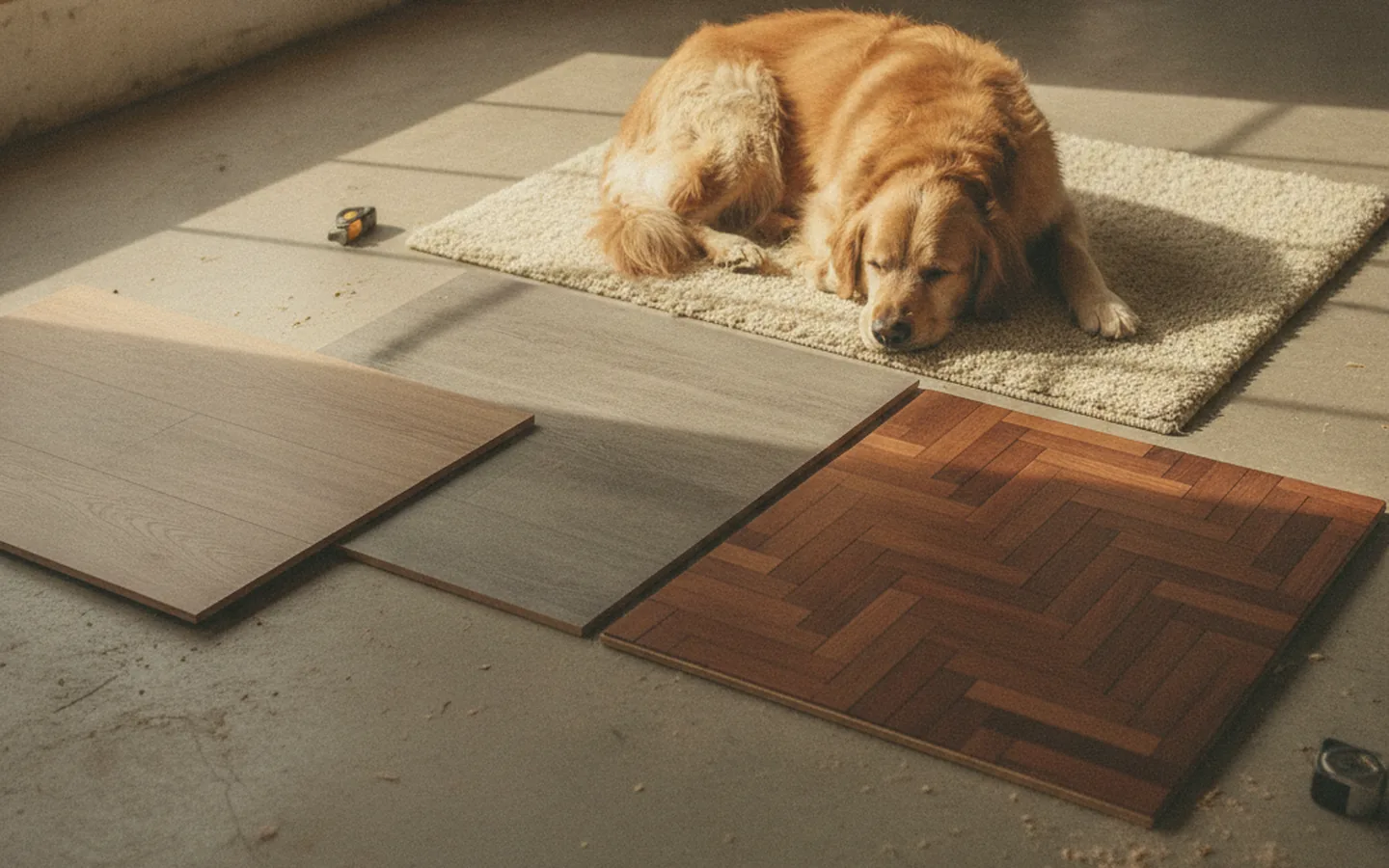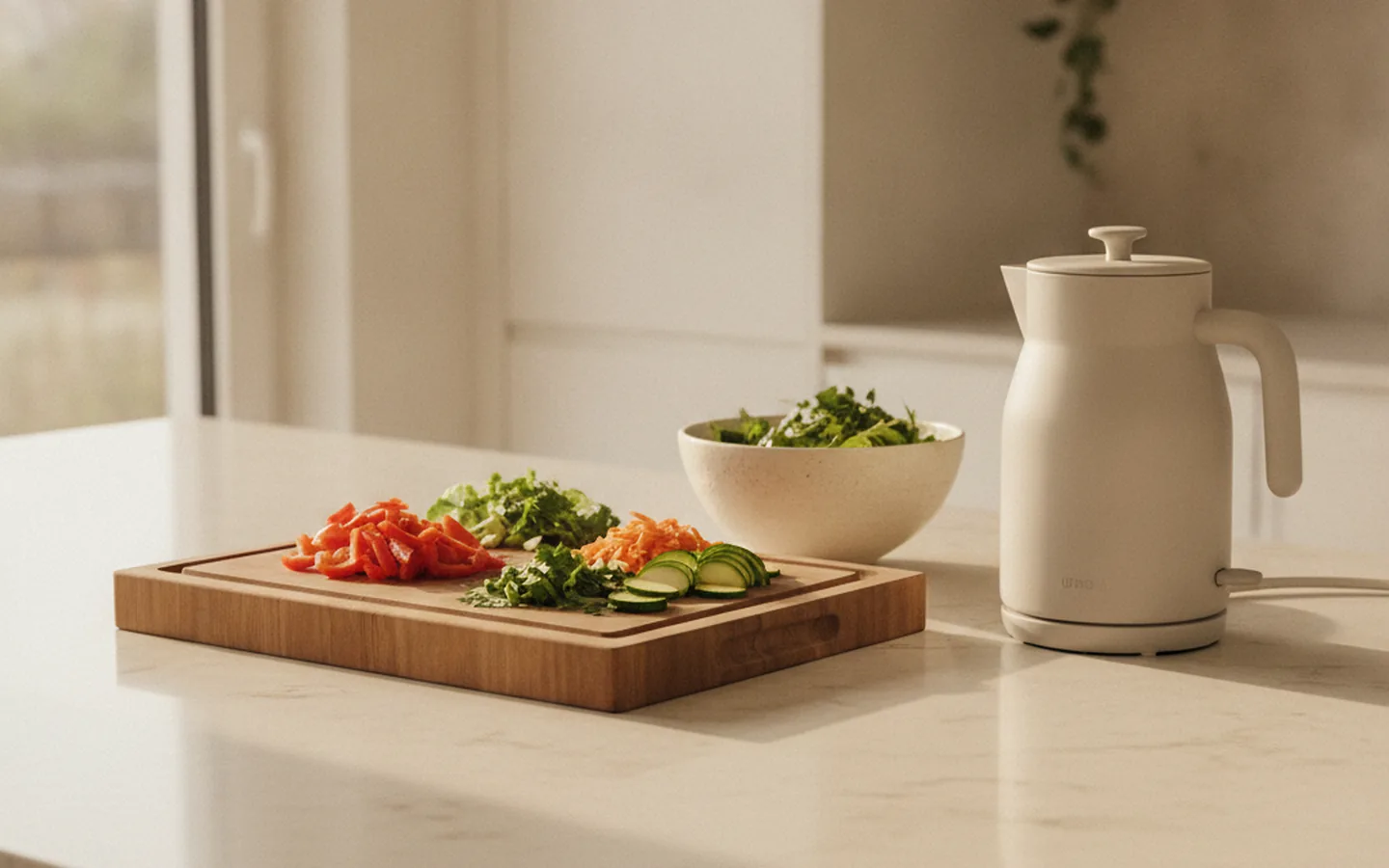
The countertop takes more abuse than anything else in the kitchen: it gets cut on, dough gets rolled out on it, hot pots get set on it, water and wine get spilled on it. And yet it's usually the last thing chosen, once the kitchen budget is almost gone. The result, a couple of years later: the edge swells near the sink, burns and scratches show up on the surface, and replacing it costs more than the difference would have been with a good material from the start.
Let's break down the five most common options: laminated chipboard, engineered stone, quartz composite, solid wood, and compact laminate. Prices are approximate, for 2026, per running meter at a standard depth of 600 mm, not including installation unless noted otherwise.
Start with your habits, not the material
Before heading to a showroom, answer a few questions for yourself. Do you cook every day, or mostly reheat food? Do you set hot items straight on the countertop, or always use a trivet? Do you always cut on a board, or sometimes right on the surface? Do you have kids who will draw, mold clay, and spill things? Do you have the patience to refresh the oil on wood every six months?
The answers quickly rule out the wrong options. For a kitchen where people cook a lot and actively, stone and compact laminate are a good fit. For tidy owners and a warm Scandinavian interior, wood works well. For a rental or a budget renovation, it makes sense to go with chipboard and plan to replace it in five to seven years.
Comparing the materials
| Material | Price per running meter, ₽ | Water | Heat | Scratches | Lifespan |
|---|---|---|---|---|---|
| Laminated chipboard (HPL) | 3,000–9,000 | Vulnerable at seams and edges | Medium | Medium | 5-10 years |
| Solid wood | 8,000–25,000 | Vulnerable without sealing | Poor | Poor, but can be sanded | 10-20 years with care |
| Engineered acrylic stone | 15,000–35,000 | Excellent | Medium | Medium, restored by polishing | 15-20 years |
| Quartz composite | 20,000–50,000 | Excellent | Good, but not above the manufacturer's limit | Excellent | 20-25 years |
| Compact laminate | 12,000–30,000 | Excellent | Good | Good | 15-20 years |
We've left out pricier materials like natural granite or large-format ceramic slabs: they're less common and cost from 40,000 ₽ per running meter and up. Granite is practically indestructible but heavy and needs reinforced cabinets, and marble is beautiful but absorbs coffee, wine, and lemon juice.
Thickness, depth, and overhang
The standard countertop depth is 600 mm, but if your layout allows it, it's worth ordering 650-700 mm: the work area becomes noticeably more comfortable, and there's room behind the faucet and outlets for jars and appliances. The front overhang above the cabinet doors is usually 20-30 mm, so drips run onto the floor instead of the cabinet fronts. Chipboard is typically 26-38 mm thick, stone 12-40 mm, and compact laminate 10-12 mm. The thinner the countertop, the more modern the kitchen looks, but the more attention you need to pay to supports and sink mounting.
A countertop doesn't wear out from age, it wears out from the owners' habits. Choose the material based on how you cook, not on a picture from a catalog.
Chipboard: a good deal if you choose right
The most common option: a particle board panel covered with decorative laminate. It looks decent, especially in solid colors and wood-look finishes, and it's inexpensive. Chipboard's main enemy is water getting into exposed cut edges. That's why the details are what determine quality here.
- Moisture-resistant panel. Ask what the core is: regular particle board swells from moisture faster.
- High-pressure HPL laminate. It’s tougher than decorative paper and scratches less.
- Rounded front edge (postforming). The laminate wraps over the edge seamlessly, so water can’t get inside.
- Sealed cutouts. The cutouts for the sink and cooktop must be coated with sealant.
- Clean seams. Corners are joined with a metal profile or sealant, not just pushed flush together.
Engineered stone and quartz
Acrylic stone
Acrylic stone is made of mineral chips bound with acrylic resin. Its main advantage is seamlessness: the countertop can be bonded to a sink made of the same material, making the joints almost invisible. A technician can remove scratches and small chips on-site by sanding and polishing. The downside: the material is sensitive to scorching-hot cookware and can yellow from high heat, so trivets are a must.
Quartz composite
Quartz composite is 90% or more natural quartz bound with resin. It's one of the hardest and most durable materials: hard to scratch, doesn't absorb liquids, and needs no sealing. Downsides: a high price, visible seams on large countertops, and chips that are hard to repair. Hot pots and pans straight off the stove are still best set on a trivet, to avoid microcracks.
Wood and compact laminate
Solid wood, most often oak, beech, or ash, makes a kitchen feel warm and cozy. It's a living material that needs attention: it's treated with oil or an oil-and-wax finish, with the protection refreshed every six months to a year. On the plus side, scratches and stains can be sanded out, and the countertop looks new again. It's not a good fit for anyone who sets wet and hot items straight on the surface and isn't ready for regular upkeep.
Compact laminate is made from many layers of paper soaked in resin and pressed under high pressure. It's only 10-12 mm thick, so the countertop looks light and modern. The material isn't affected by moisture all the way through, holds up well to impacts, doesn't absorb stains, and works with an undermount sink. Weak points: a dark edge that not everyone likes, and difficulty working with it yourself, since cutting and drilling it requires special tools.
How much a kitchen countertop costs
Let's calculate for a straight 3-meter kitchen run with cutouts for a sink and cooktop. The total includes material, fabrication, cutouts, and installation, roughly for 2026.
| Material | Total for 3 m, ₽ | Lead time |
|---|---|---|
| Chipboard with postforming | 12,000–30,000 | 1-7 days |
| Solid wood | 30,000–85,000 | 1-3 weeks |
| Compact laminate | 45,000–100,000 | 1-3 weeks |
| Acrylic stone | 55,000–120,000 | 2-3 weeks |
| Quartz composite | 70,000–170,000 | 2-4 weeks |
Keep in mind that stone and compact laminate are made to measure, after the base cabinets are installed. That means the kitchen will be without a permanent countertop for a few weeks: ask the supplier to put in a temporary chipboard slab, which is usually cheap or free.
How to care for a countertop so it lasts
- Only cut on a cutting board, even if the material resists scratches: that way you'll preserve both the countertop and the knife.
- Use a trivet for hot items, especially on chipboard, wood, and acrylic stone.
- Wipe up spilled water right away near the sink and at the seams.
- Use mild cleaners without abrasives or harsh chemicals.
- For wood, refresh the oil as the manufacturer recommends, usually every six months to a year.
- Every few years, check the sealant at the sink and seams and refresh it if it cracks.
Bottom line: chipboard works for a budget renovation or a rental, but it needs careful installation at the sink. Wood is chosen for its warmth and atmosphere, with the understanding that it needs upkeep. Acrylic stone is great for its seamlessness and repairability, quartz is nearly indestructible, and compact laminate combines durability, a slim profile, and a moderate price. Figure out how you actually use your kitchen, compare the options in the table, and don't cut corners on installation: even the best material loses its qualities with sloppy installation.
One last thing: choose the countertop together with the backsplash and the sink, not separately. The spot where the countertop, backsplash, and sink meet takes the most water, and that's exactly where the materials need to match, both in color and in how they're sealed. If you take samples home and look at them in daylight and evening light, you're much less likely to be disappointed after installation.
FAQ
Can you install a stone countertop on standard kitchen cabinets?
Acrylic stone and quartz 12-20 mm thick are usually installed on standard cabinets, sometimes with a backing of moisture-resistant plywood or chipboard. For heavy natural granite, the frame is often reinforced. Check the requirements with the manufacturer.
Which countertop handles heat the best?
Among common options, quartz composite and compact laminate hold up to temperature the best. But even for them, a trivet under anything straight off the stove is still recommended.
How long does a chipboard countertop last?
With quality installation and careful use, roughly 5-10 years. The lifespan drops sharply if water gets into the seams and the sink cutout, which is why sealing matters more here than the thickness of the panel.
This article is for informational purposes only and does not replace professional advice. Prices are approximate and current as of the review date. Found an error? Let the editors know via the contact page.