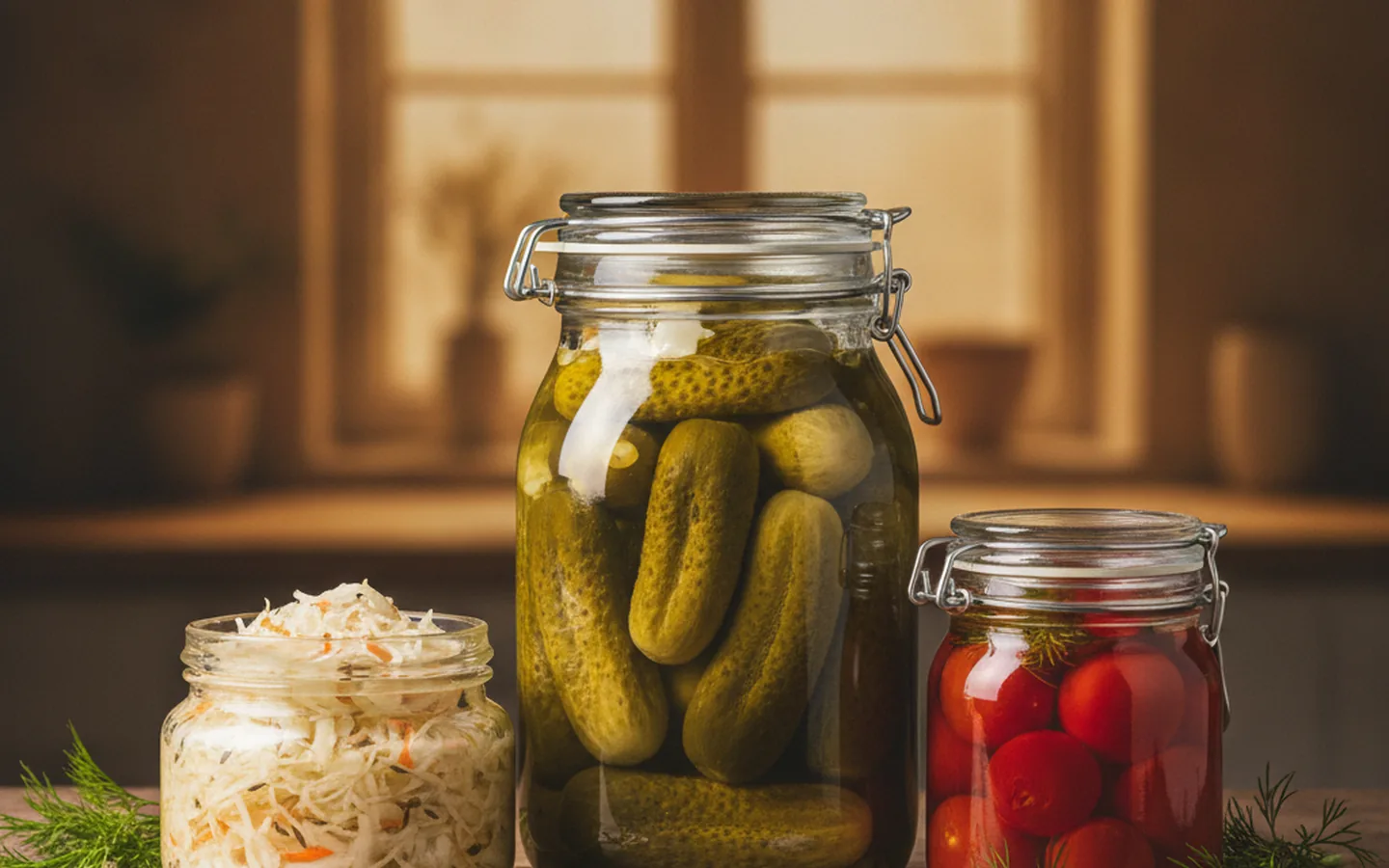
In fall, the kitchen in many homes turns into a small workshop: cucumbers, cabbage, tomatoes, peppers, zucchini. Home preserves save money and give a flavor that’s hard to find in a store. But home canning has a downside: if the process isn’t followed properly, a jar can spoil without any visible sign. In this article we break down how fermenting differs from pickling, how to properly prepare your containers, and how to store the result so you can open jars in winter with peace of mind.
Fermenting vs. pickling: what’s the difference
Both methods make food sour, but in different ways. In fermenting, acid is produced by lactic-acid bacteria that live on the surface of vegetables. They need salt, lack of air, and moderate warmth. In pickling, acid is added directly: vinegar or citric acid. Pickling is usually combined with heating and a sealed jar.
| Parameter | Fermenting (salting) | Pickling |
|---|---|---|
| Source of acid | Lactic-acid fermentation | Vinegar or citric acid |
| Heating | Not needed | Usually a hot brine and/or pasteurization |
| Time to ready | 3 days to 3–4 weeks | 1–3 weeks after sealing |
| Storage | Cold: cellar, fridge, an above-freezing balcony | A cool, dark place; fridge after opening |
| Flavor | Gentle sourness, complex aroma | Sharp acidity, predictable flavor |
| Main risk | Mold and over-souring from heat | Insufficient acidity and poor sealing |
There’s a separate category: vegetables with no acid and no salt, simply sealed in jars, and home-canned mushrooms, meat or fish. These are exactly the kinds of preserves most often linked to botulism, because in a sealed jar without oxygen or acid, dangerous bacteria can multiply and release toxin with no visible signs. If you want to can these foods, use only tested recipes with a stated acidity and processing time, and ideally choose freezing instead.
Prep: produce, salt, water
A good batch starts not with the jar, but with the vegetables. For fermenting and salting, use fresh, firm produce with no rot or soft spots. Cucumbers are best picked the same day or the day before, and cabbage should be a late variety with a tight head.
- Salt. Use plain rock salt with no additives. Iodized salt can cause softening and darkening, and fine “Extra” salt sometimes contains anti-caking agents.
- Water. Filtered or bottled drinking water works for brine. Chlorinated tap water can interfere with fermentation.
- Washing. Thoroughly wash the dirt off vegetables, especially root vegetables and herbs: the soil is where the very bacteria we’re worried about live.
- Spices. Wash dill, horseradish, garlic, and currant and cherry leaves just as thoroughly as the main vegetables.
The salt concentration for fermenting cabbage is usually 2–2.5% of the cabbage’s weight, that is, 20–25 g per kilogram. For cucumber brine, 5–7% is more common, that is, 50–70 g per liter of water. Less salt raises the risk of mold and softening; more salt slows fermentation and makes the flavor harsh.
A bulging lid and cloudy brine with no obvious cause mean one thing: the jar should be thrown out without opening or tasting it. A saved cucumber isn’t worth the risk.
Jars and lids: sterilizing without the myths
For pickles stored at room temperature, sterilizing the containers is mandatory. For fermenting in the cold, clean, scalded jars are enough. First check jars for chips and cracks around the rim: even a tiny chip breaks the seal.
Sterilizing methods
- Over steam. Hold the clean jar neck-down over boiling water for 10–15 minutes. The classic method, but slow and hot.
- In the oven. Place damp jars in a cold oven, heat to 120–150°C and hold for 15–20 minutes. Convenient for large batches.
- In a pot of water. Boil jars fully submerged in water for 10–15 minutes. Put a cloth on the bottom so the glass doesn’t crack.
- In the microwave. Pour a little water into the jar and heat on full power for 2–3 minutes. Only suitable for small batches and without metal lids.
Boil the lids separately for 3–5 minutes. Check rubber seals: if the rubber has cracked or deformed, it’s better to replace the lid. Reusing screw-top lids is fine if there’s no rust, dents or signs of corrosion inside.
Pickling: acidity and pasteurizing
The safety of a pickle rests on three things: sufficient acidity, heat, and a tight seal. If you cut back on vinegar “so it’s not so sour,” you’re removing one of the safety barriers. Adjust spices and sugar to taste, but leave the vinegar ratio in the recipe as is.
- Use recipes that state the vinegar concentration and the amount per liter of brine. 9% vinegar and 70% vinegar essence differ by a huge factor, and mixing them up is dangerous.
- Pour hot brine over the vegetables right to the top, leaving about 1 cm below the lid.
- If the recipe calls for pasteurizing, place the jars in a pot of hot water and hold them for the stated time from when it starts boiling.
- After sealing, turn the jar lid-down and check for leaks.
A common mistake: sealing using the “triple-pour” method without checking the recipe. It works for cucumbers and tomatoes in an acidic brine, but it isn’t enough for low-acid vegetables like vinegar-free zucchini, beans, or mushrooms.
If you want to swap vinegar for citric acid or apple cider vinegar, only do it following a recipe where that substitution has already been calculated. Apple and wine vinegar are usually weaker than distilled vinegar, and citric acid is dosed in grams, which is easy to under-measure by eye. Sugar, peppercorns, bay leaf, cloves and mustard seeds have almost no effect on safety and can be adjusted freely. A good habit: keep a kitchen scale and a measuring cup nearby instead of measuring salt and vinegar with heaping spoonfuls. As of 2026, a scale costs roughly from 700 ₽ and saves you from most failed batches.
Fermenting: how to manage the fermentation
The main rule for fermenting is simple: the vegetables must stay under the brine at all times. Anything sticking out is exposed to air and can grow mold. Place a plate or a smaller lid on top, with a light weight: a jar of water or a clean stone.
- For the first 2–4 days, keep the container at room temperature, 18–22°C, to get fermentation going.
- Pierce the cabbage daily with a wooden stick all the way to the bottom to release gas, and skim off the foam.
- Once the flavor turns pleasantly sour, move the batch to the cold, 0–5°C.
- Remove any white film that forms on the surface of the brine. Fuzzy, colored mold on the vegetables themselves means the batch is better not eaten.
Storage and signs of a spoiled jar
Finished pickles are stored in a cool, dark, dry place: a pantry away from the radiator, a cellar, an insulated above-freezing balcony. Fermented vegetables should be stored only in the cold, or they’ll over-sour and turn mushy. Label jars with the contents and sealing date. As a guideline: pickles are best eaten within a year, fermented vegetables within 4–6 months.
| Sign | What to do |
|---|---|
| Bulging lid, lid doesn’t flex when pressed | Throw out without opening |
| Gas bubbles in a sealed pickle jar, foam | Throw out |
| Cloudy brine in a pickle that used to be clear | Throw out |
| An unpleasant, rotten or “fermenting” smell when opened | Throw out, don’t taste |
| Cloudy brine with fermented cucumbers and cabbage | This is normal if the smell is sour and pleasant |
| White film on the surface of a ferment | Remove it, check the vegetables, move to the cold |
Keep an opened jar of pickles in the fridge and take vegetables out with a clean fork. A fork or spoon someone just ate with introduces contaminants into the brine, and it spoils faster.
When freezing is the better choice
Not everything is worth canning. Mushrooms, green peas, corn, beans, vinegar-free peppers, and berries for compote are better and safer frozen. Freezing requires no sterilization, preserves more flavor and vitamins, and carries almost no toxin risk. A 60–100-liter freezer holds the harvest from a small garden plot and costs roughly from 20,000 ₽ as of 2026, paying for itself within a couple of seasons if you preserve a lot.
Home preserving doesn’t require complicated equipment, but it does require care. Clean vegetables, the right ratio of salt or vinegar, properly prepared jars and cold storage cover most of the risks. Everything else comes down to one simple rule: if a jar raises doubts, it belongs in the trash, not on the table.
FAQ
Can you cut back on vinegar in the brine if it turns out too sour?
Not for preserves stored at room temperature: the acidity protects against dangerous bacteria. Cut back on sugar or add more spices instead, and balance out the sourness when serving. Lightly salted vinegar-free versions should be kept in the fridge only and eaten quickly.
Why did the sauerkraut turn out mushy and bitter?
Usually it is from heat and too much fermentation time, too little salt, or loose summer cabbage varieties. The bitterness often goes away if you pierce the cabbage more often to release gas. Move the batch to a cold place in time.
What should you do if strange symptoms appear after eating home preserves?
Double vision, blurred vision, weakness, dry mouth, or trouble swallowing and speaking require an immediate call to emergency services. Do not wait for it to pass, and keep the jar for testing.
This article is for informational purposes only and does not replace professional advice. Prices are approximate and current as of the review date. Found an error? Let the editors know via the contact page.