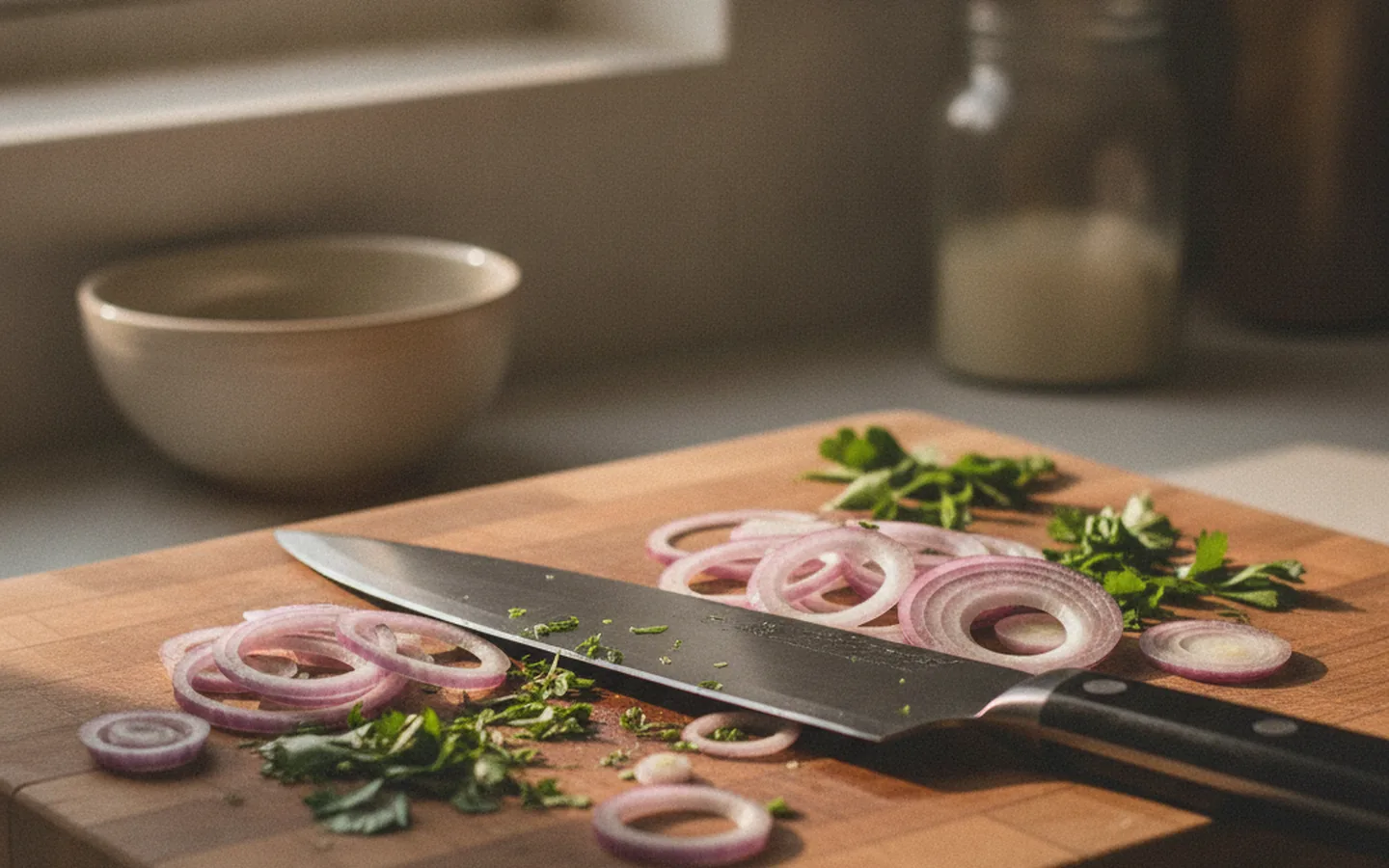
A set of seven knives in a wooden block looks impressive, but in real life most people cut with just one or two. A chef's knife handles vegetables, meat, herbs, boneless fish, and even bread, as long as it's sharp. So it makes more sense to spend money on one good blade than on a set where half the pieces just collect dust. Below we break down what to look for when choosing one, and how to make it last for years.
Prices in the article are approximate, as of 2026, and depend heavily on the store and exchange rate. Treat them as a point of comparison, not a price list.
Steel: what's written on the blade and what it means
Steel determines three things: how long the knife holds its edge, how easy it is to sharpen, and whether it's afraid of moisture. These properties pull in different directions. Very hard steel stays sharp for a long time but handles knocks against bone worse and is harder to sharpen. Soft steel forgives mistakes and hones on a rod in a minute, but dulls faster.
Hardness is usually given on the Rockwell scale (HRC). For a home knife, a comfortable range is 56-61 HRC. Below 55, the edge will roll over quickly; above 62, there's a risk of chipping with careless handling, especially when cutting on a glass or stone board.
| Steel type | Hardness, HRC | Pros | Cons |
|---|---|---|---|
| Stainless “European” (e.g., X50CrMoV15) | 54-57 | Doesn't rust, hones easily, forgives carelessness | Dulls faster, needs honing about once a week |
| Stainless “Japanese” (e.g., VG-10, AUS-10) | 59-61 | Holds its edge a long time, thin blade edge | Afraid of knocks and bones, harder to sharpen |
| Powder steel | 60-64 | Holds an edge extremely long | Expensive, needs sharpening on good stones |
| Carbon (non-alloy) | 58-62 | Very sharp, sharpens easily | Darkens and rusts, needs dry storage |
| Damascus (layered) | depends on the core | Attractive pattern | Properties are determined by the core layer, not the pattern |
Damascus steel deserves a separate mention. The pattern on the blade is almost always decorative — it comes from the cladding layers, while the core does the actual cutting. If the description doesn't specify the core steel grade, you're mostly paying for looks.
Blade shape and length
There are two classic chef's knife shapes. The European (German) style has a noticeably curved edge, good for a rocking cut without lifting the tip off the board. The Japanese gyuto is a bit straighter and thinner, better suited to a push-forward cut and fine slicing. There's also the santoku: a shorter blade with a dropped tip, popular with people who mostly cut vegetables.
- 18 cm: works well for small hands, a tight kitchen, and a narrow board. Downside: it's awkward for cutting a big cabbage or pumpkin.
- 20-21 cm: the most versatile length for home use. Good for everything from a watermelon to fine chopping.
- 24 cm and longer: convenient with a large board and experience handling knives. Usually feels unwieldy to a beginner.
- Santoku, 16-18 cm: a good choice if you rarely cut meat into large pieces.
Pay attention to the blade height at the heel. If your knuckles touch the board while cutting, the knife is too low for your hand. A height of 4.5-5 cm gives a comfortable clearance.
A sharp knife made of plain steel cuts better than a dull knife made of expensive steel. Sharpening and the habit of caring for it matter more than the steel spec on the box.
Handle, balance, and weight
You can't choose a knife from a picture — you need to hold it. Grip it with a “pinch grip”: thumb and index finger on the blade near the heel, the rest wrapped around the handle. Your hand shouldn't strain, and your fingers shouldn't press against sharp edges on the bolster or rivets.
- A wooden handle feels pleasant but doesn't like prolonged contact with water.
- Plastic or composite handles are practical and hygienic, suited to heavy cooking use.
- A heavy German knife (220-280 g) sinks into food on its own, but tires the hand during long chopping sessions.
- A light Japanese knife (150-190 g) is more precise for fine work, but needs more careful handling.
Checking balance is simple: rest the knife on your index finger where the blade meets the handle. If it sits level or tips slightly toward the handle, it will be comfortable to work with. A strong tip-heavy balance tires the wrist faster.
Sharpening: angle, honing, and stones
Even the best knife dulls. The only question is how fast, and what you'll do about it. It's important to distinguish between honing and sharpening. Honing straightens a rolled edge and restores sharpness in a couple of minutes. Sharpening removes metal and forms a new edge; it's done less often.
Sharpening angle
European knives are usually sharpened at 18-20 degrees per side, Japanese ones at 12-15. The smaller the angle, the sharper the knife, but the more delicate the edge. For a home kitchen, where bones and frozen food sometimes come up, a reasonable compromise is around 15-17 degrees.
What to sharpen with at home
- Honing rod. A steel or ceramic rod for honing. Works well for soft European steels; for hard Japanese steels, ceramic is better. A few passes before cooking keep the edge sharp longer.
- Water stones. A combination stone with a grit of 1000/3000 or 1000/6000 covers almost all home needs. You need the skill to hold the angle, which takes a few evenings to learn.
- Fixed-angle sharpeners. Simpler than stones and give a consistent result. A good option if you don't want to learn freehand sharpening.
- A professional sharpener. Once every six months to a year, you can take the knife to a professional, roughly 300-800 ₽ per knife.
It's best to avoid pull-through roller sharpeners that cost a couple hundred rubles: they quickly make a knife “look” sharp, but they tear the edge, and within a week it's duller than before.
Care that actually extends a knife's life
Most knives get ruined not from use, but from storage and washing. A few simple habits do more than switching to pricier steel.
- Wash by hand with warm water and dry immediately. The dishwasher dulls the edge and damages the handle.
- Cut on a wooden or plastic board. Glass, stone, and porcelain dull a knife within a few strokes.
- Don't scrape cut food with the edge — flip the knife over and use the spine.
- Store it on a magnetic strip, in a block, or in a sheath — not loose in a drawer.
- After washing carbon steel, you can wipe it with a drop of cooking oil.
A separate note on sheaths and stands. If the knife lives in a drawer with other utensils, get it a plastic or wooden blade cover, roughly 300–1,000 ₽. A magnetic strip on the wall is convenient, but remove the knife by turning the spine toward the magnet, not the edge — that way the edge doesn't catch on the metal. A wooden block with slots works well if the knife sits spine-down and the edge doesn't rub against the bottom of the slot. Show kids and guests right away where the sharp knife is stored, so no one grabs it blindly.
How much to spend
An expensive knife isn't necessarily the best one, but at the very cheapest end, manufacturers almost always cut corners on steel and heat treatment. Below are approximate price tiers, as of 2026.
| Budget | What to expect | Who it suits |
|---|---|---|
| up to 2,000 ₽ | Soft steel, simple handle, inconsistent quality | For a country house, temporary use, a rental apartment |
| 3,000–7,000 ₽ | Good stainless steel, decent geometry and handle | Most home cooks |
| 7,000–15,000 ₽ | Hard Japanese steel or a quality German knife | Those who cook often and are willing to sharpen |
| from 15,000 ₽ | Powder steels, handmade work, collector's models | Enthusiasts and those who value aesthetics |
A sensible strategy for most people looks like this: a mid-range chef's knife, an inexpensive small paring knife, a serrated bread knife, and a honing rod or combination stone. This combination costs less than many full sets while still covering every need.
A short pre-purchase checklist
- Figure out what you cut most often: vegetables, meat, or everything.
- Choose a shape and length: for versatility, 20 cm, European or Japanese profile.
- Check the steel and hardness; for Damascus, ask about the core steel grade.
- Hold the knife in your hand, check the grip, blade height, and balance.
- Decide right away what you'll hone and sharpen it with, and budget for that too.
A good chef's knife quickly changes your relationship with cooking: chopping stops being a chore, and food doesn't get crushed or lose its juice. And almost always, the difference between “cuts well” and “doesn't cut well” comes down not to price, but to how regularly the knife is cared for.
FAQ
Which knife should a beginner choose: European or Japanese?
A European knife made of soft stainless steel is easier to start with: it forgives mistakes, hones easily on a honing rod, and isn't afraid of the occasional knock. A Japanese knife is worth getting once you've developed the habit of careful handling and sharpening.
How often should you sharpen a chef's knife?
With regular cooking, you hone it every few days or before each use, and do a full sharpening on stones every 2-6 months. Go by feel: if the knife slides off a tomato's skin instead of biting in, it's time to sharpen.
Can a good knife be washed in the dishwasher?
It's best avoided, even if the manufacturer allows it. Hot water, harsh detergents, and knocking against other dishes dull the edge and damage the handle. Washing by hand and drying it right away takes less than a minute.
This article is for informational purposes only and does not replace professional advice. Prices are approximate and current as of the review date. Found an error? Let the editors know via the contact page.