Getting a child ready for first grade becomes the first big school budget for many families. Lists on social media grow every year, stores roll out “ready-made first-grader kits” in August, and the parents' chat throws in new items every week. As a result, some things get bought twice, and others stay unopened until second grade. Below we break down what the budget consists of, what's actually needed by September 1, and where you don't need to rush.
All amounts in the article are approximate, as of 2026. They're higher in big cities and noticeably lower in the regions and during sales. It's important to look at the structure, not just the final number — that makes it easier to see where your spending runs above average.
What to buy first
There are things a child can't start school properly without, and they barely depend on the requirements of a specific school. You can buy them ahead of time, over the summer, without rushing and at calmer prices.
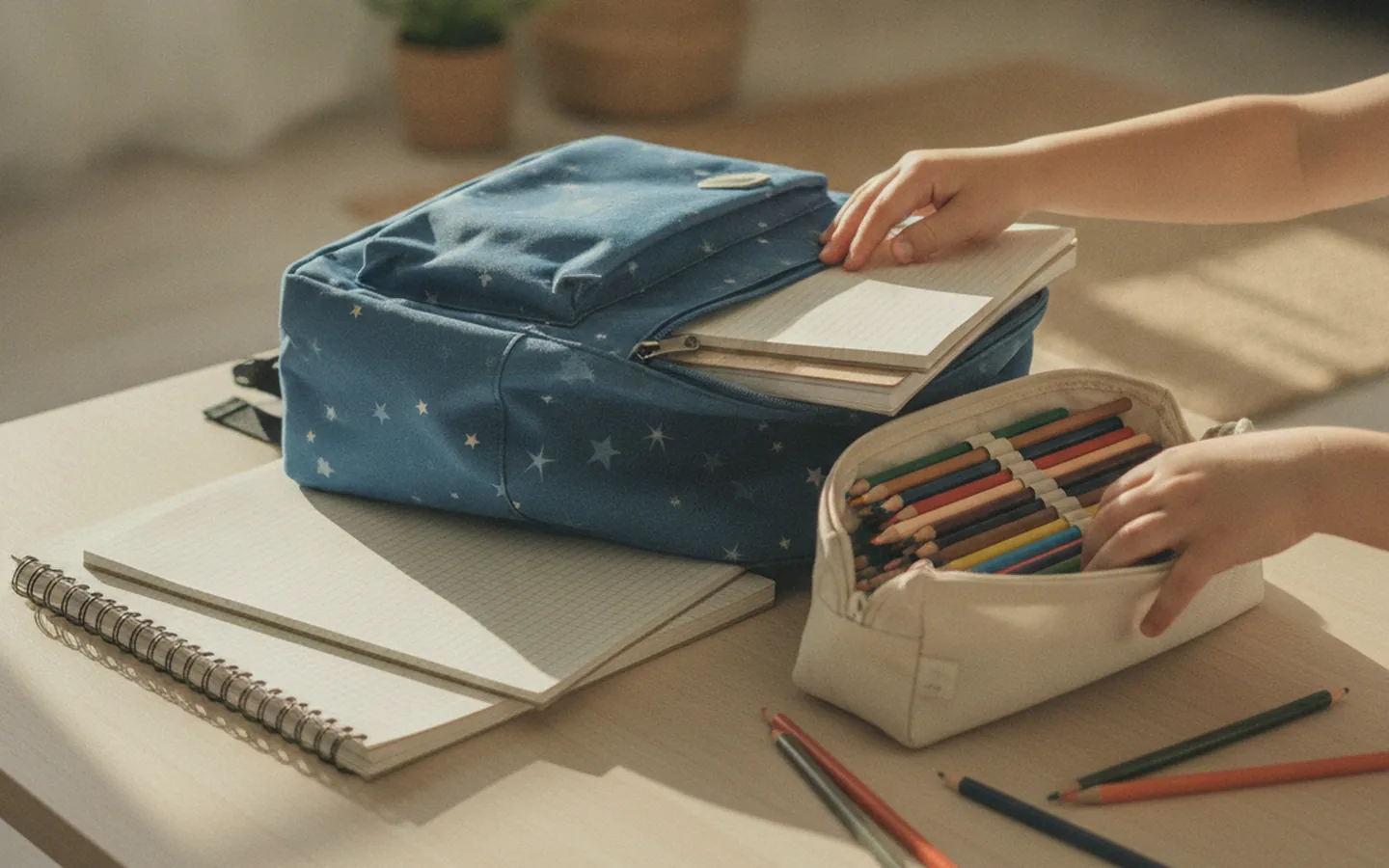
- Backpack. With a rigid orthopedic back panel, wide adjustable straps, and reflective elements. An empty backpack for a first-grader should ideally weigh no more than 700-900 g.
- Indoor shoes and a bag for them. Comfortable shoes or sneakers with a light-colored sole, if the school requires it.
- Gym kit. A T-shirt, shorts or leggings, a tracksuit for outdoors, and sneakers for the gym.
- Basic uniform or school clothes. First find out whether the school has a mandatory style, and only then buy.
- Pencil case and basic writing supplies. Plain pencils, pens, an eraser, a sharpener, a ruler, colored pencils.
Approximate budget by category
The table lists typical expenses for one first-grader. The lower bound corresponds to a careful basic set, and the upper bound to mid-range purchases without extras.
| Article | Basic option, ₽ | Mid-range, ₽ |
|---|---|---|
| Backpack and shoe bag | 3,000–5,000 | 7,000–12,000 |
| School uniform (one spare set) | 5,000–8,000 | 10,000–18,000 |
| Shoes: indoor and outdoor | 4,000–6,000 | 8,000–14,000 |
| Gym kit and shoes | 3,000–4,000 | 5,000–8,000 |
| Stationery for the first term | 2,000–3,500 | 4,000–6,000 |
| Workbooks and handwriting books | 1,000–2,500 | 2,500–4,000 |
| Outfit and flowers for the opening ceremony | 1,500–3,000 | 3,000–6,000 |
| Approximate total | 19,500–32,000 | 39,500–68,000 |
After-school care, clubs, school meals, class contributions, and prep classes can show up as a separate line item. These are already regular monthly expenses, and it's better to count them in the overall family budget rather than in “back-to-school shopping.”
The most expensive back-to-school mistake: buying everything in July from a generic list off the internet, then getting a completely different one from the teacher in August.
What's better to buy after meeting the teacher
Usually at the end of August the teacher holds a meeting and hands out their own list. It can include specific requirements: notebooks with narrow or slanted ruling and a certain number of pages, specific workbooks, cover color, album format. If you buy everything ahead of time off the internet, you'll likely have to swap or add to some of it.
- Ruled and squared notebooks: the teacher usually specifies the quantity and type.
- Workbooks and handwriting books: they need to match the textbooks and curriculum the school chose.
- Folders for crafts and art class, and their contents: clay, colored paper, scissors, glue.
- Textbook covers: sizes depend on the specific editions, and textbooks are issued at school.
- Student planner: in first grade it's often not used at all, or is replaced by a digital one.
Good practice: in July, buy only the big items, and get the small stuff a week before school using the exact list. Stationery prices in the last week of August don't rise as much as it seems, and you end up making far fewer mistakes.
What you can skip entirely
Before heading to the store, check what you already have at home: pencils, markers, scissors, glue, and clay often survive from preschool. Make a list of what's missing and take only that to the store — not a child with wide eyes in front of the bright stationery display. It's the simplest way to stay on budget.
Every year parents spend money on things that are barely needed in first grade, or aren't needed right away. You can easily save up to a third of the budget on these items.
- Ready-made first-grader kits. They contain a lot of items that won't end up on the teacher's list, and the stationery quality is usually average.
- Expensive transformer pencil case. It's heavy, breaks often, and is distracting in class. A simple zippered pencil case works better.
- Branded stationery with cartoon characters. It costs 1.5-2 times more than plain stationery and loses its appeal fast.
- A second uniform set right away. Wait a month: it will become clear how quickly the uniform gets dirty and whether a replacement is needed.
- A smartphone by September 1. You can stay in touch with your child using a simple feature phone or a kids' smartwatch. The smartphone decision is better made separately and calmly.
- Extra educational workbooks. The first-grade curriculum is already packed, and the teacher will provide or specify the handwriting books and notebooks.
Swapping within the family and with neighbors saves a lot of money: lower-grade school uniforms get outgrown fast, and parents happily sell or give away nearly new ones in parent chats. The same goes for backpacks: if an older child's backpack is in good shape and the right size, there's no need to replace it just for the sake of something new.
Clothes and shoes: what to look for
In first grade, a child spends 4-6 hours at school, or until evening with after-school care. Clothes should be comfortable, warm but not hot, and easy enough that the child can change for gym class by themselves.
- Fabrics with a high cotton or viscose content: they're more comfortable than synthetics.
- Pants and skirts with a soft elastic or adjustable waistband: kids grow fast.
- Shoes with velcro instead of laces, if the child doesn't tie laces confidently yet.
- Label everything: uniforms, indoor shoes, and jackets look alike across the whole class and get mixed up.
Workspace at home
Another line item that people remember at the last minute is a spot for homework. There isn't much of it in first grade, but the child needs their own desk and chair that fit their height. The desk should sit roughly at the level of the sitting child's solar plexus, feet should rest on the floor or a footrest, and knees should be bent at about a right angle. Adjustable-height desks and chairs that grow with the child are most convenient: as of 2026, a set costs roughly 8,000 to 25,000 ₽, but it lasts through the end of elementary school and beyond. A desk lamp with warm or neutral light should be placed on the left for a right-handed child and on the right for a left-handed one, so the hand doesn't cast a shadow on the notebook. If the family already has a suitable desk, it's enough to pick a chair and a footrest — there's no need to buy an entire separate “school corner” set.
How to spread out spending over time
If you cram everything into the last two weeks of August, the budget feels heavier than it actually is. Spreading purchases across the summer is much more comfortable.
| When | What to buy |
|---|---|
| June | Backpack, pencil case, gym shoes on sale |
| July | Uniform (if the style is known), outdoor shoes, bag for indoor shoes |
| Early August | Indoor shoes, basic stationery: pens, pencils, erasers |
| After the school meeting | Notebooks, workbooks, craft and art supplies, covers |
| First weeks of September | Buying as needed: a second uniform set, whatever the teacher asks for |
How to prepare more than just the backpack for school
Shopping takes up a lot of attention, but for a first-grader a calm routine and confidence matter more. A couple of weeks before school, gradually shift bedtime and wake-up time toward the school schedule, walk the route to school and back together, and show them where the classroom and cloakroom will be, if possible. Let the child pack the backpack themselves a couple of times “as practice” — that way they'll learn to find their things faster and worry less over small stuff.
Getting ready for first grade doesn't have to cost as much as a vacation. If you buy the big items ahead of time, the small stuff off an exact list, and skip the unnecessary extras entirely, the budget becomes predictable — and on September 1 you can think about the celebration instead of the receipts.
FAQ
How much does it cost to get a child ready for first grade in 2026?
Roughly, as of 2026, a basic set will cost 20,000–30,000 ₽, and a mid-range set 40,000–70,000 ₽. The total depends heavily on the uniform, backpack, and shoes, not on stationery.
Do you need to buy an expensive orthopedic backpack?
Construction matters more than price: a rigid back panel, wide straps, low weight, and the right size. A good mid-range backpack meets these requirements just as well as a premium one.
What if the teacher's list only arrives at the end of August?
That's normal. Buy the big items ahead of time, and get the notebooks, workbooks, and craft materials after the parents' meeting. In the first days of September, teachers are usually relaxed about things being bought a bit later.
This article is for informational purposes only and does not replace professional advice. Prices are approximate and current as of the review date. Found an error? Let the editors know via the contact page.