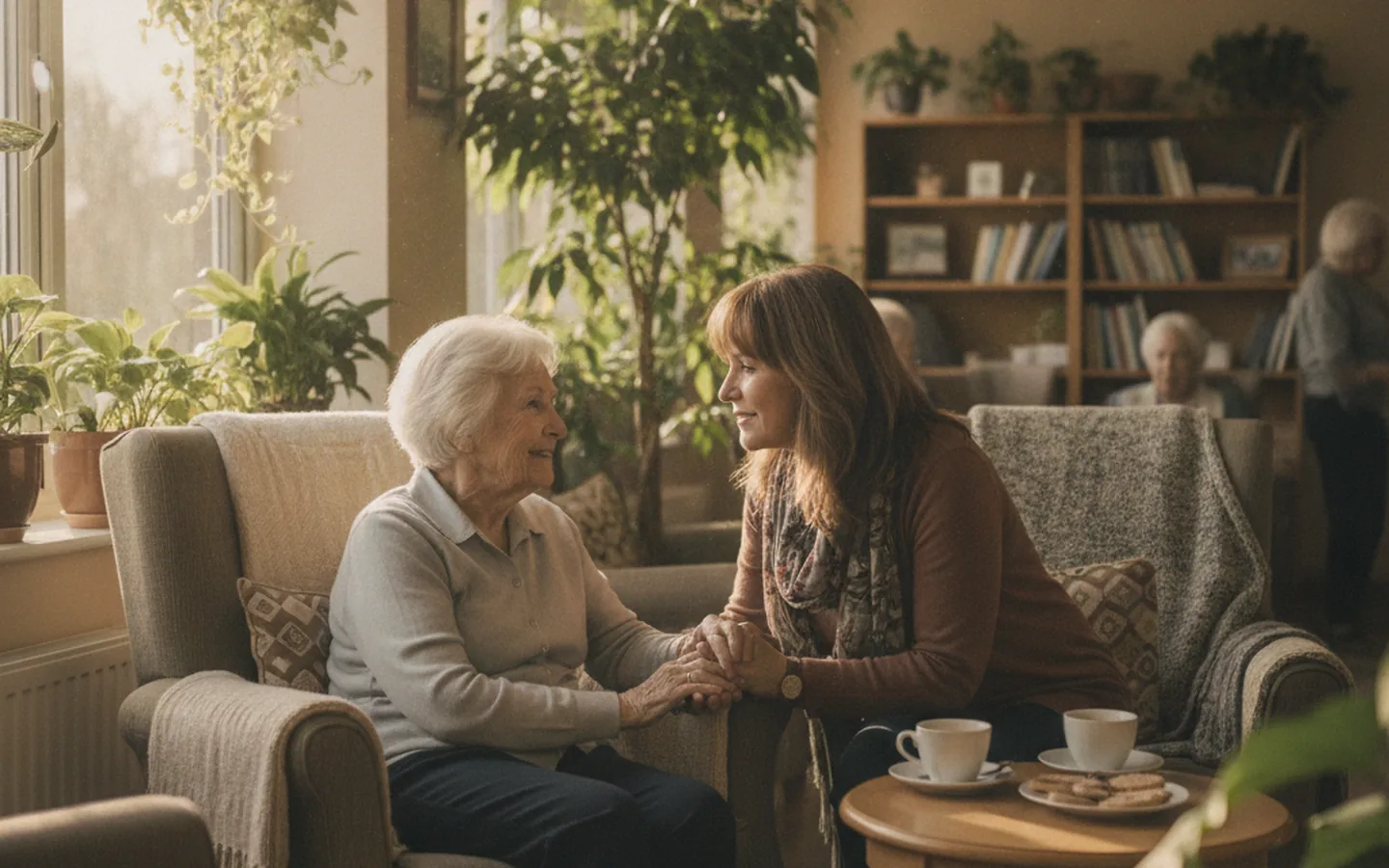
The decision to move an elderly parent into a care facility is almost never easy. It's usually preceded by months of trying to manage alone, sleepless nights, and guilt. But sometimes home can no longer provide safety and proper care: the person falls, forgets to turn off the stove, can't take their own medication, and relatives work and live in another part of town or in another city. In that case, a well-chosen care facility isn't “giving up” on someone — it's taking care of them.
We've put together what to look at when choosing a private care facility for a senior, what questions to ask on site, and how to work out the real cost. Prices in this article are approximate, for 2026. Be sure to discuss health questions and the required level of medical care with the person's doctor or a geriatrician.
Start with an assessment: what level of care is actually needed
Care facilities differ a lot in who they're set up to work with. Some are built for active older adults who need company, meals, and oversight. Others specialize in bedridden residents, people recovering from a stroke, or people with dementia. A mistake here is costly: either the person overpays for medical care they don't need, or ends up somewhere that simply can't handle their condition.
Before calling care facilities, honestly answer a few questions, ideally together with a doctor:
- can the person stand up, walk, wash, and dress on their own, or do they need help;
- how many medications do they take, and can they manage that without supervision;
- are there memory problems, disorientation, or a tendency to wander off;
- what chronic conditions need monitoring: diabetes, heart failure, after-effects of a stroke;
- do they need a special diet, pureed food, or help eating.
With this list in hand, your conversation with a care facility's administrator becomes concrete, and you'll quickly see whether the place is the right fit.
If your relative has dementia, look for facilities that explicitly state this as a specialty. These facilities have safe walking routes worked out, coded locks on the doors, and caregivers who know how to calmly handle anxiety, nighttime activity, and food refusal. A general-purpose facility “for everyone” often can't handle this well.
Paperwork and legal status
In Russia, seniors are admitted by state-run residential care homes and private care facilities. State-run ones are cheaper, but their waiting lists can be long, and conditions vary a lot by specific institution. Private ones operate under a contract, and that's where it's important to check the legal side.
Ask to see the organization's registration documents. If a facility advertises medical services (IV drips, dressing changes, physician monitoring), it needs a medical license for those specific activities, and you can check whether it has one in public registries. It's worth asking whether the organization is listed in the regional registry of social service providers: in some regions this allows part of the stay to be paid for through budget programs. Check the details with your local social protection office.
The best care facility isn't the one with the prettiest lobby — it's the one where staff know residents by name and don't look away when you ask an uncomfortable question.
Staff: the main thing you're paying for
Renovations and furniture are visible right away, but the quality of care is determined by the people. Ask how many caregivers work on the floor during the day and at night, and how many residents each staff member is responsible for. For people with limited mobility, a reasonable caseload is noticeably lower than for independent residents. Find out whether there's a nurse on staff around the clock and how often a doctor visits.
Ask about turnover: if half the caregivers change within six months, an older person won't have time to get used to them. Ask how staff are trained to work with dementia, and how they handle a resident who's aggressive, refuses food, or tries to leave. A good answer sounds specific, with examples. A vague “everything's fine here” should raise a flag. Ask to meet the caregiver who'll actually be working with your relative, and talk with them for at least a few minutes.
Pay attention to location too. A countryside facility surrounded by pine trees looks appealing, but if the drive there takes three hours, relatives will visit rarely, and regular visits from loved ones matter more to an older person than fresh air. Work out how long the drive takes by car and by public transit, and whether there's a hospital nearby in case of an emergency admission.
Safety and an accessible environment
Older people fall most often in the bathroom, on stairs, and at night on the way to the toilet. Check how the space is set up:
- grab bars in hallways and bathrooms, non-slip flooring, a curbless shower;
- call buttons by the bed and in the bathroom, and how quickly staff respond to them;
- an elevator or ground-floor placement for residents with limited mobility;
- adjustable beds and pressure-relief mattresses for bedridden residents;
- a fire alarm system, an evacuation plan, and night lighting in hallways;
- exit monitoring for residents with memory impairment.
Meals, activities, and personal space
Ask how many times a day residents are fed (usually five meals), who plans the menu, and whether diets are accommodated. It's a good sign if you can try lunch during your visit. Check whether residents eat in a common dining room: shared meals support social contact, while food served in the room to everyone across the board often points to understaffing.
Activities matter a lot for an older person's mental state: walks, exercise, board games, music, crafts, memory exercises. Ask for the schedule and check whether the activities actually happen. And ask whether a favorite armchair, photos, a blanket, or a TV can be brought along. Familiar belongings make a big difference in settling into a new place.
What it costs and what's included in the price
The cost depends on the region, the number of people per room, and the level of care. As a rough guide for 2026, a spot in a private facility in the regions costs 35,000 to 60,000 ₽ a month; in Moscow and the surrounding Moscow region, 60,000 to 150,000 ₽ and up. Care for bedridden residents and people with dementia is usually 20 to 40% above the base rate.
Be sure to ask what's included in the price and what's billed separately: diapers and hygiene products, medication, specialist visits, escorted trips to the clinic, haircuts, laundering personal items. Because of these add-ons, the final bill sometimes ends up a quarter higher than quoted.
Compare not just the final totals, but the payment schedule. Many facilities take a month's prepayment plus a deposit, and refund money with deductions on early departure. Ask for a sample contract and a price list for extra services ahead of time, so you can compare two or three options calmly at home.
Visit checklist
Visit at least twice, once unannounced, ideally during lunch or in the evening. Bring this list with you:
| What to check | Good sign | Warning sign |
|---|---|---|
| Smell and cleanliness | fresh air, clean bathrooms and rooms | persistent urine smell, dirt in the corners |
| Residents | dressed, groomed, occupied with something | lying down all day, unkempt, everyone parked in front of the TV |
| Staff | know people by name, speak respectfully | irritation, rushing, a harsh tone |
| Answers to questions | specific, with numbers and documents | evasive, “we'll show you later” |
| Meals | varied menu, can be sampled | no menu, or it doesn't match reality |
| Visits | relatives can come at any convenient time | strict restrictions with no explanation |
| Contract | lets you take it home and review it | pressures you to sign right away |
After the move, don't disappear. The first few weeks are the hardest: visit often, stay in touch with staff, keep an eye on your relative's weight, mood, and skin condition. If something's off, raise it right away, and for serious violations, don't be afraid to switch facilities. The right care facility handles that kind of scrutiny calmly.
One more thing: prepare the person themselves for the move. Tell them ahead of time where they're going and why, and visit together for a tour if their condition allows. Pack belongings that matter to them, not just the practical ones. The more an older relative feels the decision was made with them, not for them, the faster they'll settle in.
FAQ
How is a private care facility different from a state-run residential care home?
State-run facilities are cheaper, but they often have waiting lists and less flexibility in choosing conditions. Private facilities operate under a contract, admit residents faster, and are more flexible on service, but cost more, and you need to check their quality yourself.
Can someone stay at a care facility temporarily first?
Many care facilities accept short-term stays: while relatives are on vacation, or during recovery after a hospital stay. It's a good way to check out the place and let an older person get used to it without making a final decision.
Does the older person's own consent matter?
Yes — if they have legal capacity, the contract is signed with their consent. Discuss the move ahead of time and honestly, and involve them in the choice: adjustment goes noticeably easier that way.
This article is for informational purposes only and does not replace professional advice. Prices are approximate and current as of the review date. Found an error? Let the editors know via the contact page.