Almost every adult sleeps badly from time to time: taking forever to fall asleep, waking up in the middle of the night, getting up exhausted. Often the cause isn’t a serious illness but a cluster of small things: coffee too late, a phone in bed, a stuffy bedroom, sleeping in until noon on weekends. Sleep hygiene is the set of habits and conditions that help the brain and body switch into rest mode. Below is a practical checklist, plus the signs that mean self-help measures alone aren’t enough anymore.
How much sleep you need and how to tell it’s not enough
Most adults need 7–9 hours of sleep a night, but the exact amount varies person to person. Go by how you feel during the day rather than a specific number. If you wake up without an alarm at roughly the same time, stay focused during the day, and don’t nod off in meetings or behind the wheel, you’re probably getting enough sleep.
- You can’t get up without an alarm, and even with one you keep hitting snooze.
- You feel the urge to nap during the day, especially after lunch and on public transit.
- Concentration and memory decline, irritability increases.
- On weekends you sleep 2–3 hours longer than on weekdays.
- You crave sweets and coffee just to “make it” to evening.
Schedule: the main lever
The body’s internal clock is set mainly by light and regularity. If you go to bed and wake up at different times, your body struggles to know when it’s time to sleep. So the first item in any plan is a consistent wake-up time, weekends included. A difference of up to an hour is fine, but shifting by three or four hours works like a mini jet-lagging flight every single week.
- Pick a wake-up time you can actually stick to every day.
- Count back 7.5–8 hours from it: that’s roughly your bedtime.
- Start a “quiet hour” 30–60 minutes before bedtime, with no work and no stimulating screens.
- Get out into daylight as early as possible in the morning, for at least 10–15 minutes.
- If you feel sleepy during the day, keep naps to 20–30 minutes and no later than midday.
The first week on a new schedule can feel awkward: you’re not tired at night and it’s hard to get up in the morning. Usually, within 1–2 weeks the internal clock adjusts, as long as weekends don’t throw it off again.
Sleep doesn’t switch on at the push of a button. You can only set the stage for it: with light, temperature, a schedule, and a quiet hour before you lie down.
The bedroom: light, quiet, cool
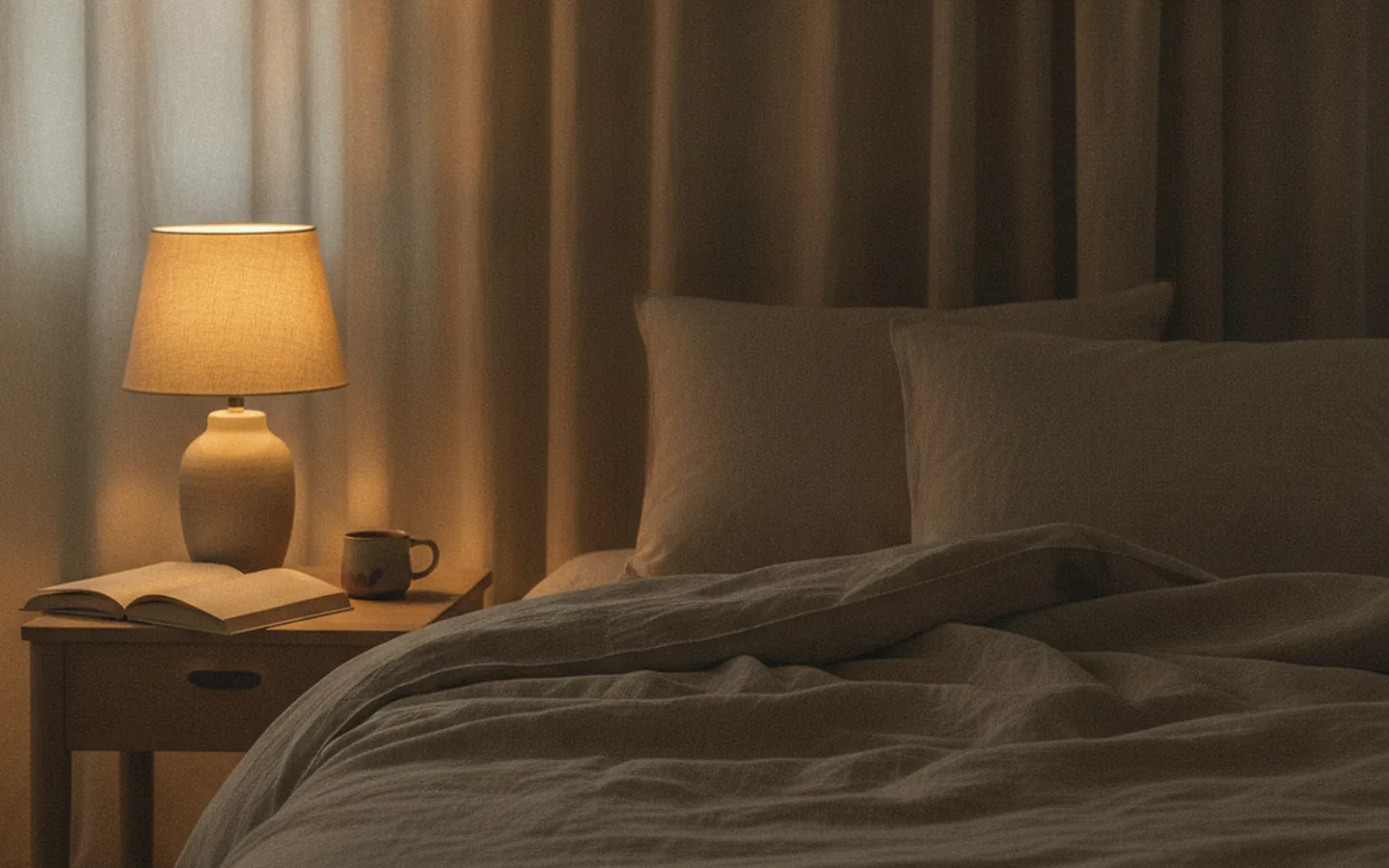
The bedroom should signal to your brain that this is where sleep happens. The fewer distractions in it, the easier it is to fall asleep and the fewer night wakings you’ll have. Walk through your bedroom with this checklist.
| Parameter | Target | What you can do |
|---|---|---|
| Temperature | Around 18–20 °C | Air the room before bed, turn down the radiator, use a light blanket in summer |
| Light | Complete darkness | Blackout curtains, a sleep mask, cover device indicator lights |
| Noise | Silence or a steady background sound | Earplugs, a white noise machine, window seals |
| Humidity | Around 40–60% | A humidifier during the heating season |
| Bed | A comfortable mattress and pillow | Replace the mattress if it’s 8–10 years old and sagging |
| Devices | Phone and laptop out of the bed | Charge your phone in another room, use a regular alarm clock |
If you’re buying a new mattress or pillow, as of 2026 a good mid-range mattress costs roughly 20,000–50,000 ₽, and a pillow 2,000–6,000 ₽. More expensive doesn’t mean better: what matters is that your spine stays aligned and your shoulders and hips aren’t pressed into the surface.
Evening habits: a checklist
Many sleep problems start hours before bedtime. Go through the list and note which of these apply to you.
- Caffeine. Coffee, strong tea, energy drinks and cola stay active for several hours. It’s best to have your last cup before 2–3 pm.
- Alcohol. It helps you fall asleep faster, but it makes sleep shallower and causes waking in the second half of the night.
- A late dinner. A heavy, fatty or spicy meal an hour before bed makes it harder to fall asleep. Eat dinner 2–3 hours before bed; a light snack at night is fine.
- Screens. Bright light and an endless news feed are stimulating. Switch your phone to night mode and put it away an hour before bed.
- Intense workouts. Vigorous exercise late in the evening keeps some people from falling asleep. It’s better to finish 2–3 hours before bed.
- Work and serious conversations. Answering a work email at 11 pm switches on your anxiety mode. Push it to the morning.
- Smoking. Nicotine stimulates the nervous system and makes falling asleep harder.
What to do instead
Fill the quiet hour before bed with whatever actually relaxes you. A warm shower, reading a paper book under soft light, light stretching, breathing exercises, an unhurried walk all work well. If tomorrow’s to-dos are spinning in your head, write them down on paper: that takes off some of the pressure.
Special cases: shift work, young kids, heat
Not everyone can go to bed at the same time. With shift work, it helps to at least make sleep after a night shift as close to nighttime sleep as possible: blackout curtains or a mask, earplugs, phone on silent, and household members given a heads-up. On the way home in the morning, sunglasses help: bright light at that hour throws the internal clock off the most. If shifts rotate constantly, ask your employer for a “forward” rotation (day, evening, night) — it’s easier to adjust to.
Parents of infants don’t have access to a proper schedule, and that’s normal. Different rules apply here: sleep when the baby sleeps, split nighttime wake-ups with your partner, don’t spend the baby’s naptime on cleaning. After a few months the family’s routine stabilizes, and that’s when you can go back to the checklist.
In the heat, without air conditioning, it helps to air the room out at night and early morning, keep curtains closed during the day, use thin cotton or linen bedding, and take a cool shower before bed. Point a fan so it circulates air around the room rather than blowing directly on you.
If you can’t fall asleep
Lying in bed fuming about insomnia almost never helps. If you can’t fall asleep after about 20 minutes, get up, move to another room with dim lighting, and do something calm: read, listen to quiet music. Go back to bed once you feel drowsy. Don’t check the clock every 10 minutes: counting the remaining hours only ramps up the anxiety.
Many people look for a solution in sleeping pills and “natural” sleep supplements. Don’t start taking these on your own: some are habit-forming, interact with other medications, and mask the underlying cause of the problem. Any sleep medication should be discussed with a doctor.
When to see a doctor
Sleep hygiene helps with most mild, temporary issues. But there are situations where the right move isn’t adjusting your bedroom, it’s getting checked out. You can start with a GP, who can refer you to a neurologist, sleep specialist, cardiologist or therapist if needed.
Before the appointment, it helps to keep a sleep diary for two weeks: what time you went to bed, roughly how long it took to fall asleep, how many times you woke up, what time you got up, how much coffee and alcohol you had, and how you felt during the day. Keeping this takes a couple of minutes a day and gives the doctor far more to work with than a vague “I sleep badly.” If a partner sleeps next to you, ask them to record your snoring on their phone: that’s valuable information for a specialist too.
| Sign | Why it matters |
|---|---|
| Loud snoring with breathing pauses that family members mention | Possible sleep-disordered breathing, which affects the heart and blood pressure |
| Severe daytime sleepiness, dozing off while driving or mid-conversation | Life-threatening and may indicate an underlying condition |
| Insomnia more than 3 times a week for over a month | Can be linked to anxiety, depression, hormones |
| Uncomfortable sensations in the legs in the evening, an urge to move them | Needs a dedicated workup |
| Waking up due to pain, shortness of breath, frequent urination | Points to a condition that needs treatment |
| Low mood, anxiety, thoughts that nothing matters | Needs professional help, not just a schedule change |
Start with one or two habits, not the entire list at once. After a couple of weeks of a steady wake-up time, a dark cool bedroom, and phone-free evenings, many people notice they fall asleep faster and wake up more refreshed. If sleep doesn’t improve, that’s a reason to stop putting up with it and book a doctor’s appointment.
FAQ
Can you catch up on a whole week’s sleep over the weekend?
Partly. An extra hour to ninety minutes of sleep reduces accumulated fatigue, but shifting your wake-up time by several hours throws off your internal clock, making it harder to fall asleep on Monday. It’s more reliable to add sleep on weekdays instead.
Is napping during the day harmful?
A short 20–30 minute nap earlier in the day doesn’t hurt most people and can even help. A long nap, or one late in the day, can make nighttime sleep worse. If you can’t function without a nap, that’s a reason to discuss the cause of the sleepiness with a doctor.
Does melatonin help with insomnia?
Melatonin is sometimes used for jet lag and schedule disruptions, but the decision to take it, and at what dose, should be made together with a doctor. It doesn’t address the underlying causes of insomnia and isn’t right for everyone.
This article is for informational purposes only and does not replace professional advice. Prices are approximate and current as of the review date. Found an error? Let the editors know via the contact page.