
Ask five founders how long their MVP took and you'll get five different answers, and almost none of them will match the number the team quoted at kickoff. Part of the gap is honest underestimation, and part of it is that "MVP" gets used to describe projects that range from a weekend prototype to a two-sided marketplace with payments and matching logic built in. Before you can plan around a timeline, you need to know which kind of MVP you're actually building, and what typically happens to each kind once development starts.
This guide breaks the question into the parts that actually drive a schedule: the complexity tier your idea falls into, what happens inside each development phase, whether your choice of platform adds weeks you didn't plan for, and the handful of ordinary mistakes that turn a reasonable estimate into a missed deadline. None of it requires a technical background to follow, and by the end you should be able to place your own idea on the timeline table below with reasonable confidence rather than guessing at a number that sounds right.
Key Takeaways
- A simple, single-platform MVP with one core workflow typically takes 4 to 8 weeks; a standard cross-platform build runs 8 to 16 weeks, and a two-sided marketplace or AI-enabled product can stretch past 20 weeks.
- Core development eats the largest share of the schedule, but discovery and QA are the phases most often rushed or skipped, and both come back to cost more time later when they are.
- Scope creep, not a difficult feature, is the most common reason an estimated 10-week build turns into six months.
- App Store review can add one to three days on top of a finished build, and Android review can add a few hours; neither is large on its own, but both are easy to forget when setting a launch date.
How Long Does It Take to Build an MVP, Really?
For most small businesses and early-stage founders, a minimum viable product takes 8 to 16 weeks from kickoff to a working release, assuming a single core workflow and a reasonably experienced team. Simpler single-feature MVPs can land at the 4-to-8-week mark, while two-sided marketplaces, products with real-time matching, or anything built around an AI feature routinely run 16 to 24 weeks or longer. The range is wide on purpose: complexity, not ambition, is what actually drives the number.
What makes this hard to estimate from the outside is that the word "MVP" hides a lot of variation. A single-screen tool that solves one problem for one type of user is a different build than an app with two user roles, a backend admin panel, and a payment flow, even though both get called an MVP in a pitch deck. The complexity breakdown below is the fastest way to find where your own idea actually sits.
Team size matters less than most founders assume. Adding a third or fourth developer to a project rarely compresses the schedule in proportion to the headcount, because coordination between people takes time too, and a small, experienced team that already works well together will frequently outpace a larger one still learning how to collaborate. The complexity of the product itself, not the size of the roster building it, is what the ranges below are built around.
The MVP Timeline by Complexity
Complexity, more than team size or budget, is the single biggest driver of how long an MVP takes. The table below groups MVPs into four tiers based on what the product actually has to do, not how big the company behind it is.
| MVP type | Typical timeline | What's included |
|---|---|---|
| Simple MVP | 4–8 weeks | One core workflow, single platform, minimal backend, no third-party integrations |
| Standard cross-platform MVP | 8–16 weeks | A few core features, iOS and Android (or web and mobile), basic backend and user accounts |
| Marketplace or two-sided MVP | 16–22 weeks | Two user types, matching or discovery logic, payments, messaging between parties |
| AI- or XR-enabled MVP | 16–24+ weeks | Everything in a standard build, plus model integration, data or prompt tuning, and heavier testing |
Most ideas that founders describe as "simple" when they first pitch them actually land in the standard tier once you count user accounts, basic settings, and a way to reset a forgotten password. That's not a bad thing, it just means the realistic planning number is closer to three months than three weeks.
It's also worth separating a product's complexity from its polish. A simple MVP with a rough, unstyled interface and a standard MVP with a fully designed one can sit in roughly the same development-time band, because the extra design and animation work tends to run in parallel with development rather than adding to the critical path. Where complexity genuinely adds time is in the logic underneath the screens: how many types of users the system has to recognize, how many states a piece of data can move through, and how many places an error can realistically occur.
What Happens in Each Phase of MVP Development
An MVP timeline is really four phases stacked end to end, and each one has its own failure modes if it gets rushed or skipped entirely.
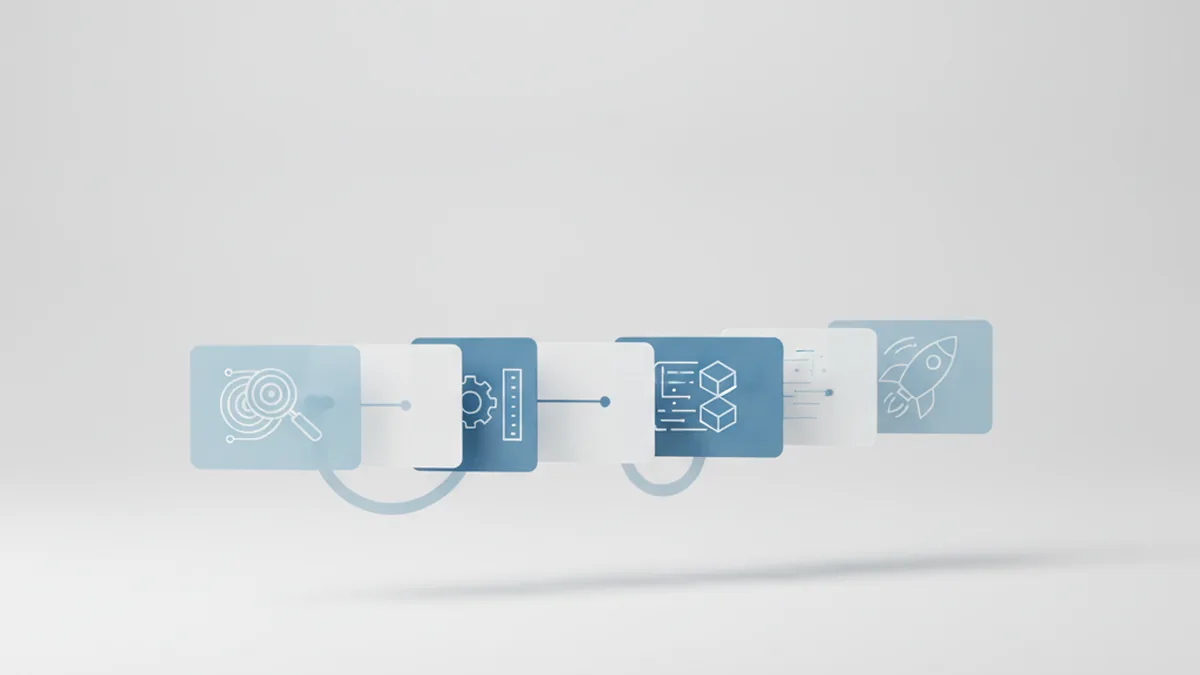
Discovery and Scoping (1–3 Weeks)
Discovery is where the team turns a rough idea into a written scope: what the MVP will and will not do, who the first users are, and which single workflow the product has to nail before anything else. Skipping this phase feels like it saves time up front, but it almost always shows up later as scope arguments mid-build, which cost far more than a week of planning would have. A good discovery phase also produces a short list of open technical questions, so the team isn't making architecture decisions blind once development starts.
Design and Prototyping (2–4 Weeks)
This phase turns the scope into wireframes or a clickable prototype that shows the core user flow before a single line of production code gets written. For a genuinely simple MVP, this can be compressed into a lightweight set of screens rather than full visual design, but some version of this step should exist, because catching a confusing flow on paper is a day of rework and catching it in a finished app is a week. This is also the natural point to test the flow with a handful of real prospective users, since feedback on a prototype is cheap and feedback on a finished build is not.
Core Development (6–14+ Weeks)
This is where most of the calendar time goes: building the actual features, the backend that supports them, and the logic that connects the two. It's also the phase most vulnerable to scope creep, since new feature ideas tend to surface constantly once the team is deep in the code and can see what's technically possible. Experienced teams typically break this phase into one- or two-week sprints with something demoable at the end of each, which makes slippage visible early rather than all at once in week twelve.
QA, Testing, and Launch (2–4 Weeks)
Testing covers functional bugs, but for an MVP it also means checking the product under conditions real users will create: slow connections, unexpected input, and the edge cases nobody thought to specify in the scope document. Compressing this phase to hit a launch date is one of the more common ways a technically "finished" MVP turns into a rocky first week in production. Launch itself is more than flipping a switch, it typically includes setting up basic analytics so the team can see how the first users actually behave, which matters more for an MVP than for a mature product, since that data is what decides what gets built next.
Does the Platform Change the Timeline?
Yes, and the difference can be larger than founders expect going in. A web-app MVP is usually the fastest to ship, since there's no app store review and no need to build two separate native codebases. A cross-platform mobile app using a shared codebase for iOS and Android sits in the middle, while two fully native apps, one for each platform, take the longest because the team is effectively building and testing two products instead of one.
| Platform approach | Typical added time vs. a comparable web MVP |
|---|---|
| Web app only | Baseline, no app store review |
| Cross-platform mobile (shared codebase) | +1 to 3 weeks for mobile-specific testing |
| Native iOS + Android (separate codebases) | +3 to 6 weeks for building and testing two platforms |
One detail that rarely makes it into early planning: app store review itself takes time, even after development is finished. Apple's App Store review typically runs one to three days, while Google Play's Android review is often measured in hours rather than days. Neither number is large by itself, but a launch date set without it tends to slip by exactly that much, usually at the worst possible moment.
What Makes an MVP Take Longer Than Expected?
Teams rarely miss a deadline because of one dramatic technical problem. It's almost always a combination of smaller, ordinary causes that compound over the course of a build.
- Scope creep. Small feature additions that each sound reasonable in isolation, but together turn a defined 10-week build into a six-month one. This is rarely one big decision; it's a dozen small "while we're in there" requests that nobody flagged as a scope change.
- Slow decision-making. Every day a founder takes to approve a design or answer a question is a day the development team is either blocked or guessing, and guessing usually means rework later. On a 12-week project, even a handful of multi-day delays on decisions can add two or three weeks to the calendar without a single line of code changing.
- An inexperienced team or unfamiliar stack. A team learning a new framework while also building the product adds a real, if hard-to-quantify, tax to every estimate, because debugging unfamiliar tooling takes longer than debugging something the team has shipped five times before.
- An unclear value proposition going into development. If the team can't describe in one sentence what the MVP needs to prove, requirements tend to shift mid-build as that question gets answered the hard way, usually after a feature has already been partly built against the wrong assumption.
- Third-party dependencies outside the team's control. Waiting on a payment provider's approval, an API access request, or a design asset from an outside contractor can stall a build for days at a time, and these delays rarely show up in an initial estimate because they're easy to forget until they actually happen.
Two Real MVP Timelines, Side by Side
Patterns are easier to see in two contrasting examples than in abstract ranges alone.
A two-person team building a simple scheduling tool for independent contractors scoped one core workflow: book a slot, get a confirmation, see an upcoming schedule. With no app store submission (it shipped as a web app) and a single platform to test, the whole build landed in just under seven weeks, close to the top of the simple-MVP range.
By contrast, a founder building a two-sided marketplace connecting local tutors with students needed matching logic, in-app messaging, and payment processing before a single transaction could happen. Discovery alone took three weeks because the two-sided nature of the product meant mapping two very different user journeys, and the full build ran just past five months, landing inside the marketplace-tier range even though the team worked efficiently throughout.
The difference between these two outcomes isn't team quality, it's structural. The scheduling tool had one user type and one linear flow, so almost every decision the team made moved the project forward in a straight line. The marketplace had two user types whose needs sometimes pulled in different directions, plus a payment integration that introduced its own review and compliance steps outside the team's direct control, and both of those are exactly the kind of complexity the timeline table above is built to capture.
How to Speed Up an MVP Without Hurting Quality
There's a real difference between cutting corners and cutting scope, and the fastest MVP builds tend to do a lot of the second and very little of the first.
- Cut features, not quality. Ship the one workflow that proves your core assumption, and hold everything else for a fast-follow release once you have real user feedback to prioritize against.
- Work in short, visible sprints. Weekly or two-week check-ins catch scope drift and flow problems early, while they're still a conversation instead of a rebuild.
- Reuse what already exists. Authentication, payments, and basic admin panels rarely need to be built from scratch; no-code tools and off-the-shelf components can cover these without custom engineering time.
- Bring in a team that's done this before. Experience compresses a timeline more reliably than adding headcount does. If you're comparing options, look at some of the top MVP development companies — teams like YuSMP Group build and ship MVPs for founders on exactly this kind of timeline, and an experienced team tends to hit the faster end of each range above rather than the slower one.
If you haven't locked in your MVP's scope yet, it's worth stepping back to validate the idea first, since a timeline built around the wrong workflow is a timeline you'll end up redoing. And if budget, not time, is the constraint you're solving for, our guide to what to cut from a tight MVP budget covers that decision in more depth, alongside our broader MVP budget guide.
MVP vs. Prototype vs. Final Product: Why It Matters for Your Timeline
These three terms get used almost interchangeably, but they represent very different amounts of work. A prototype is a clickable mockup used to test an idea with users before any real code is written, and it can often be ready in days. An MVP is a working product with real data behind it, even if the feature set is deliberately thin, which is why it takes weeks rather than days. A final, fully-featured product adds the polish, edge-case handling, and secondary features that an MVP intentionally defers. Confusing a prototype's timeline with an MVP's, or an MVP's with a finished product's, is one of the quieter reasons launch dates get set wrong before a single developer is hired.
This also matters for how you talk about your own project with investors, contractors, or a co-founder. Calling a clickable prototype an "MVP" in a pitch can set expectations for a working product that doesn't actually exist yet, and calling an MVP a "finished product" invites feedback about missing features that were deliberately left out on purpose. Getting the vocabulary right up front saves a surprising number of awkward conversations later in the timeline.
FAQ
How long does it take to build an MVP for a SaaS product?
Most SaaS MVPs that cover one clear workflow take 10 to 16 weeks from kickoff to a working release, which lines up with the standard-complexity range in the timeline table above. A SaaS product with multiple user roles, billing, and integrations with other tools usually pushes past that into the 16-to-22-week range, closer to a marketplace-style build.
Can you really build an MVP in 30 days?
Yes, but only for the simplest case: a single core workflow, one platform, no backend complexity, and a team that skips a separate design phase in favor of an existing template. That is the four-to-eight-week simple MVP band, and it works best for validating one specific assumption rather than launching a full product.
Is an MVP the same thing as a prototype?
No. A prototype is usually a clickable mockup used to test an idea with users before any real code is written, while an MVP is a working product with real data and real users behind it, even if the feature set is deliberately thin. Confusing the two is a common reason timelines get estimated wrong, since a prototype can be ready in days and an MVP cannot.
What slows an MVP down the most?
Scope creep is the single biggest delay in practice: small feature additions that each sound reasonable on their own but collectively turn a 10-week build into a 20-week one. Slow decision-making from the founder's side and an unclear value proposition going into development are close behind, since both cause rework after code has already been written.
Do I need a separate design team for an MVP?
Not always as a dedicated phase, but you do need someone thinking through the user flow before development starts, even if it is a lightweight set of wireframes rather than full visual design. Skipping this step entirely tends to save one to two weeks upfront and cost more than that later in rework once development reveals flow problems nobody caught on paper.
How much longer does an AI feature add to an MVP timeline?
An MVP built around an AI or machine-learning feature typically falls in the 16-to-24-plus-week range, longer than a standard cross-platform app, mainly because of the extra time needed for model integration, prompt or data tuning, and testing edge cases that do not show up until real users start typing unpredictable input. Teams that treat the AI feature as an add-on to a simpler core product can sometimes ship the non-AI parts faster and layer the AI piece in afterward.
There's no single correct MVP timeline, only a timeline that matches what you're actually building. Use the complexity tier that fits your idea honestly, budget extra time for the phase you're most tempted to rush, and treat any estimate that doesn't account for platform, scope, and your own decision speed as a guess rather than a plan.
This article is for informational purposes only and does not replace professional advice. Found an error? Let the editors know via the contact page.