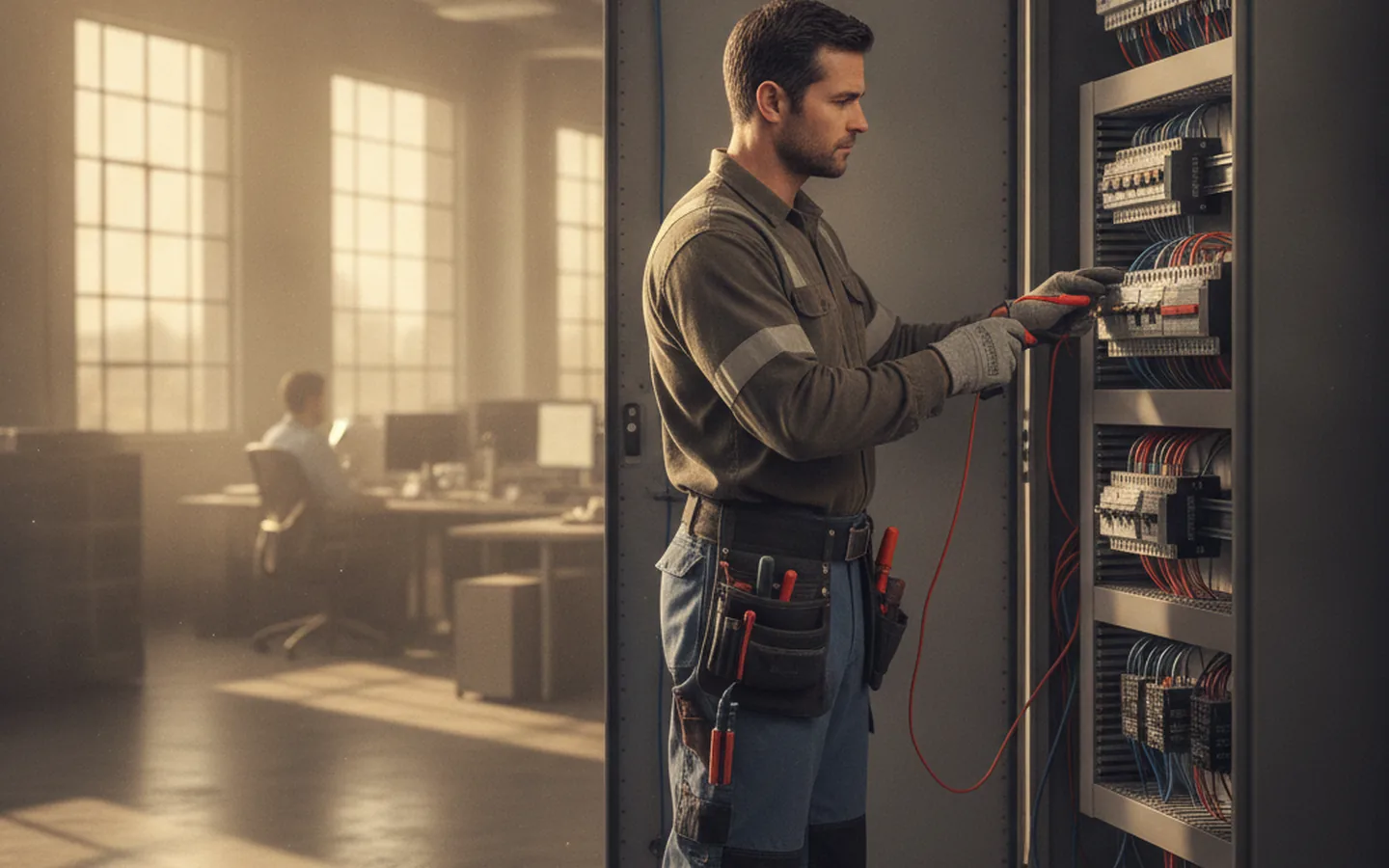
Electrical work in an office, shop or café rarely crosses a business owner’s mind while everything is running fine. But it accounts for a notable share of fires in commercial premises, and downtime from a tripped breaker during rush hour costs more than a year of maintenance. Below we break down which electrical services a business needs, when to order them and roughly what they cost.
Prices in this guide are approximate, for 2026, for million-plus cities. In smaller cities they are usually lower, and higher in Moscow and St. Petersburg. The exact cost always depends on the floor area, the condition of the wiring and the amount of equipment.
First, figure out what you’re responsible for
Most small businesses operate out of leased premises, and the first question is where the landlord’s zone of responsibility ends. Look for the answer in two places. First: the lease agreement, which usually states who maintains the internal wiring and who pays for its repair. Second: the balance-of-responsibility act with the utility company. It shows up to which point the network belongs to the utility or the building owner, and where yours begins.
Within your own zone, the business must appoint someone responsible for the electrical system. In a small company this can be the manager or an employee who has completed training and an electrical-safety knowledge check, or the function can be handed to a contractor under an agreement. This is often remembered only during an inspection, even though setting it up takes about two weeks.
Electrical testing and the technical report
This is the basic service to start with. An accredited electrical testing lab checks the insulation resistance of the cables, the operation of the circuit breakers and residual-current devices, the quality of the grounding and the reliability of the connections. The output is a technical report with test certificates. This is exactly what the fire inspector, the insurance company and often the landlord itself will ask for.
As a rule, testing is done when the premises are commissioned, after wiring repairs and then periodically: for most offices and shops the typical interval is once every three years, and for higher-risk spaces (wet areas, food production, workshops) more often, up to once a year. The approximate cost for a small office starts from 15,000 ₽, and for a café with a kitchen or a warehouse with equipment from 30,000 to 80,000 ₽.
Electrical work in commercial premises is not just lights and outlets — it’s also the documents that a fire inspector and a landlord will ask for first.
Design and installation when opening or renovating
If you’re moving into a space to fit your own concept, the wiring almost always has to be redone: relocating outlets for workstations, running dedicated lines for kitchen or refrigeration equipment, adding low-voltage networks. You need to start with a design. It’s needed not just for approvals: it shows how much power the equipment will draw and whether what’s allocated to the premises is enough.
A power-supply design for a space up to 200 m² costs roughly from 25,000 to 70,000 ₽. Turnkey installation with materials is usually priced per square meter: from 1,500 to 3,500 ₽ per m² for an office, and more for food service, where there are many power lines. It’s not worth saving on cable and breakers: the difference in the estimate is small, while the consequences of cheap materials show up a year or two later as overheating and outages.
Panel, capacity and metering
The distribution panel is the heart of the system. In older premises you’ll often find panels assembled decades ago for a completely different load. Signs it’s time for an upgrade: breakers trip regularly, the enclosure or wires feel hot, there are no residual-current devices on the outlet circuits, there’s no labeling and no one understands which breaker controls what.
- Panel modernization with replacement of the breakers and labeling: roughly from 30,000 to 120,000 ₽ depending on the number of circuits.
- Increasing the allocated capacity: a procedure through the utility company, taking from several weeks to several months. The cost depends on the amount and the region, and it’s best to find out before signing the lease.
- Replacing or relocating the meter and connecting it to remote reading: from 8,000 to 25,000 ₽, not including the cost of the meter itself.
If you’re planning to install a combi oven, powerful air conditioners or machinery, check the allocated capacity as early as the stage of choosing the premises. A shortfall of a few kilowatts can delay opening by months.
Lighting: task, emergency, escape-route
Good lighting affects both sales and employee fatigue. An office needs even illumination of workstations without glare on monitors, a shop needs accent lighting on merchandise, and a café needs warm, dim light in the dining area and bright light in the kitchen. Switching to LED fixtures usually pays for itself in one to two years through savings on electricity and lamp replacement.
A separate mandatory item: emergency and escape-route lighting. “Exit” signs and fixtures along escape routes must run on a backup source if the mains go down. The fire authority checks this, and missing or faulty signs are among the most common violations found. Installing the system for a small space costs roughly from 20,000 to 60,000 ₽. Motion sensors in back rooms, corridors and restrooms add savings at almost no extra cost.
Maintenance and emergency call-outs
Scheduled maintenance includes inspecting the panel, tightening connections, testing the residual-current devices with the “Test” button, replacing burnt-out fixtures and thermal-imaging inspection. The latter is especially useful: the camera shows overheated connections long before they start to melt. A one-off thermal-imaging survey of a small site costs roughly from 5,000 to 15,000 ₽.
For networks and sites with a lot of equipment, a service contract is more cost-effective: from 8,000 to 30,000 ₽ per month depending on the floor area and the schedule. It usually includes scheduled visits, priority emergency call-outs and the function of the person responsible for the electrical system. Without a contract, an urgent electrician call-out at night or on a day off will cost roughly from 3,000 to 7,000 ₽ for the call-out alone, plus labor and materials.
To make budgeting easier, let’s put the main services into one table. The amounts are approximate, for 2026, and serve as a starting point for comparing estimates.
| Service | When it’s needed | Approximate price, 2026 |
|---|---|---|
| Electrical testing and the technical report | on commissioning, after repairs, periodically | from 15,000 ₽ |
| Power-supply design | opening, remodeling, new equipment | from 25,000 to 70,000 ₽ |
| Turnkey installation | renovation of premises | from 1,500 to 3,500 ₽ per m² |
| Panel modernization | old panel, frequent outages | from 30,000 to 120,000 ₽ |
| Emergency lighting | always, checked by the fire authority | from 20,000 to 60,000 ₽ |
| Thermal-imaging inspection | once a year or if overheating is suspected | from 5,000 to 15,000 ₽ |
| Service contract | networks of sites, lots of equipment | from 8,000 ₽ per month |
Also think through backup power. For a cash register, a server rack, refrigerated display cases or medical equipment, even a short outage means lost money. An uninterruptible power supply for the register and network equipment costs roughly from 10,000 to 40,000 ₽, while a diesel or gas generator with automatic backup transfer for a café or small production facility will run into the hundreds of thousands of rubles. The choice depends on how much you lose per hour of downtime.
How to choose a contractor
- Ask to see the electricians’ electrical-safety qualifications and, for testing, the lab’s documents.
- Check whether the contractor issues as-built documentation: a single-line panel diagram and a cable-routing diagram. Without it, any electrician coming after will be working blind.
- Compare estimates line by line: cable brand, breaker manufacturer, number of points. The same total amount can hide different materials.
- Fix the warranty period for the work and the response time for an emergency call in the contract.
- Ask about experience with sites of your type: a restaurant kitchen and an open-plan office need different solutions.
FAQ
Who pays for electrical work in a leased space?
This is set by the lease agreement and the balance-of-responsibility act. In most cases the tenant maintains the internal wiring beyond the panel, while the building owner is responsible for the service entrance and the main line, though other arrangements happen too.
How often do you need electrical testing?
For ordinary offices and shops, the typical interval is about three years; for higher-risk spaces, more often. Unscheduled testing is done after wiring repairs and after connecting new high-power equipment.
Can an in-house facility manager handle the electrical work?
Minor jobs, yes, if the employee holds the appropriate electrical-safety qualification and has passed a knowledge check. Testing, panel installation and live-wire work are better left to a specialized company.
This article is for informational purposes only and does not replace professional advice. Prices are approximate and current as of the review date. Found an error? Let the editors know via the contact page.