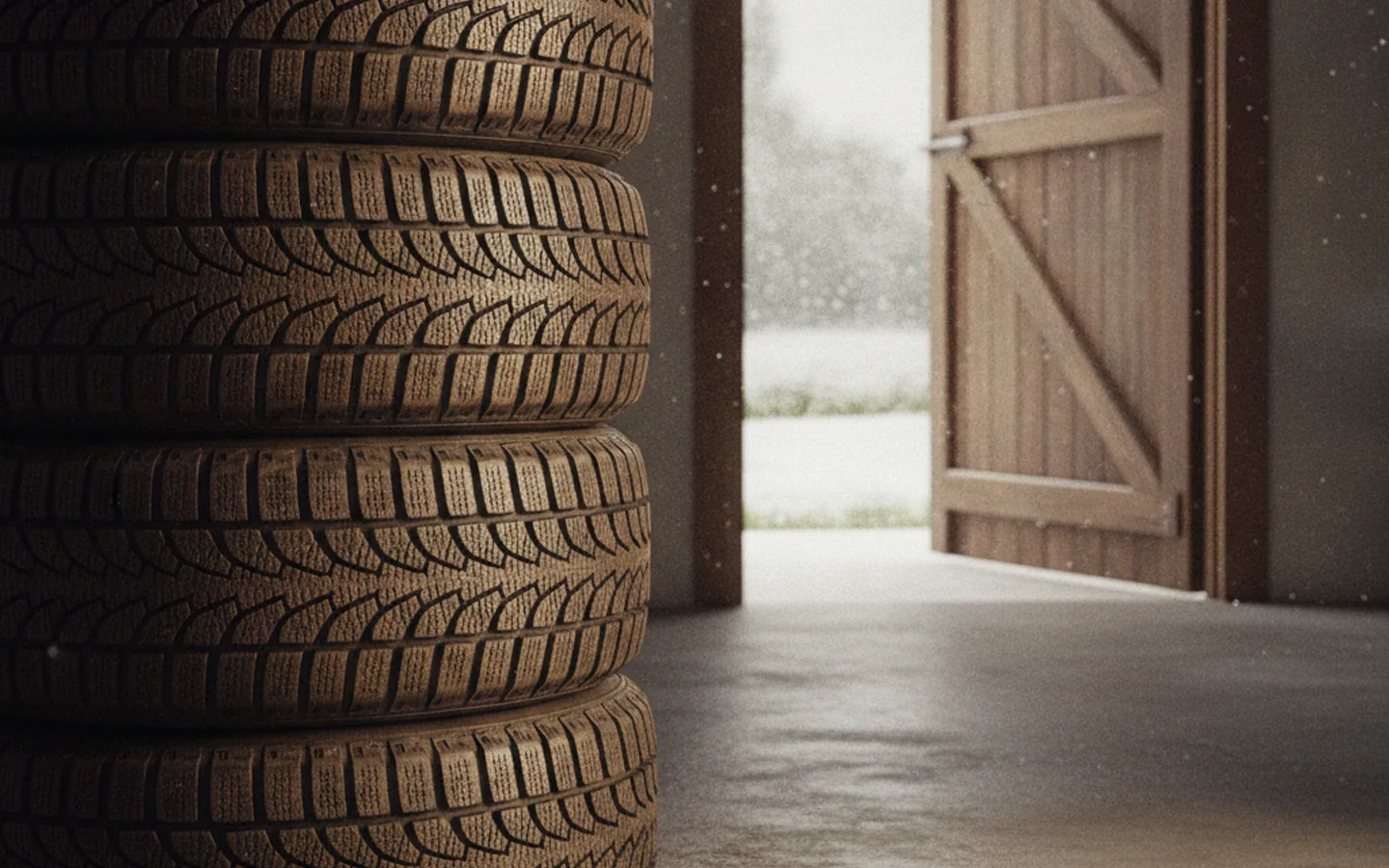
It's better to choose winter tires in summer, not during the first snowfall. In July, stores have the full range of sizes in stock, there are no lines at the tire shop, and you can take your time comparing options. In November you'll end up with whatever's left in the warehouse and pay extra for urgency. Below we break the choice down step by step: stud type, size, markings, budget, and storage.
All prices are approximate, for 2026, and depend on size, manufacturer, and region. Brand names are deliberately left out here: a single brand can have both good and poor models, so it's the specific tire's parameters that matter.
Studs or studless: it depends on your route
The main question for a winter choice is this: where and how do you drive. A studded tire works thanks to metal studs that dig into ice and packed snow. A studless, or “friction,” tire holds the road with a soft rubber compound and a dense network of fine grooves (sipes) that grip surface irregularities.
| Criterion | Studded | Studless |
|---|---|---|
| Clear ice, black ice | Best of all, shortest stopping distance | Noticeably worse, needs caution |
| Packed snow | Confident | Good |
| Wet and dry asphalt | Longer stopping distance, noisy | Quieter and more stable |
| Slush and de-icing chemicals | Average | Average to good |
| Cabin noise | High, especially on asphalt | Low |
| Wear | Studs pop out under aggressive driving | Tread wears faster during thaws |
| Best for | Highways, suburbs, regions with black ice | Big city with regular snow clearing |
If you live in a big city where streets are cleared and salted, and you rarely drive out of town, studless tires will be quieter, more comfortable, and no worse on real roads. But if you regularly drive on highways, to the outskirts, to a country house, or live somewhere where thaws alternate with black ice, studded tires are almost the obvious choice. For small towns with poor snow clearing and hilly terrain, studs are also the safer bet.
Size: get the one listed for your car
The permitted tire sizes are listed in the owner's manual, on the plate in the driver's door jamb, or on the fuel-filler flap. Manufacturers often allow several options. For winter there's a simple rule: among the permitted sizes, it makes sense to pick the one with a smaller rim diameter and a taller profile.
- A taller profile handles potholes and ruts better, and is less prone to sidewall bulges and wheel damage.
- A narrower tire cuts through slush better and is less prone to hydroplaning in wet snow.
- A smaller diameter is usually cheaper: the price difference between R16 and R18 in the same model can reach 30-40%.
- Don't go outside the permitted sizes: it affects how the ABS works and the speedometer reading, and it can become a problem in an insurance claim.
The right winter tire isn't picked from an online rating — it's picked for your roads: cleared city asphalt and a snowbound highway call for different rubber.
How to read the sidewall markings
Almost everything you need to know before buying is coded onto the tire's sidewall. Take the marking 205/55 R16 94T as an example.
| Code | What it means |
|---|---|
| 205 | Tread width in millimeters |
| 55 | Aspect ratio as a percentage of the width |
| R16 | Radial construction, 16-inch rim diameter |
| 94 | Load index: up to 670 kg per wheel |
| T | Speed index: up to 190 km/h |
| Three-peak mountain with a snowflake symbol | The tire has passed winter testing |
| M+S | Mud and snow: on its own doesn't guarantee winter performance |
| DOT with a four-digit code, e.g. 2526 | Manufacture date: week 25 of 2026 |
Pay attention to the three-peak mountain with the snowflake symbol. The M+S mark appears on all-season tires and even on some summer off-road tires, so on its own it doesn't guarantee winter performance. The load and speed indexes should be no lower than those specified for your car. For winter it's acceptable to choose a speed index lower than the factory one, but keep the limit in mind and don't exceed it.
Tire freshness
Rubber ages even in storage, but under good conditions this happens slowly. A tire up to two or three years old at the time of purchase is considered normal. If a seller offers a five-year-old set at a discount, think twice: winter compound hardens over time, and cold-weather grip deteriorates before the tread even wears down.
Budget: what a set costs
The price depends on size, tire class, and where you buy. Add tire mounting to the cost of the rubber, and storage if needed. Below are approximate ranges for 2026 for a set of four tires.
| Size | Budget segment, ₽ | Mid segment, ₽ | Premium segment, ₽ |
|---|---|---|---|
| R14-R15 | 18,000–26,000 | 26,000–38,000 | 38,000–55,000 |
| R16 | 24,000–34,000 | 34,000–50,000 | 50,000–75,000 |
| R17-R18 | 34,000–48,000 | 48,000–75,000 | 75,000–120,000 |
| R19 and larger | 48,000–70,000 | 70,000–110,000 | 110,000–180,000 |
Add tire mounting for the set to these amounts (roughly 2,500–5,000 ₽ depending on diameter and whether you're swapping tires on rims or just the tires), plus seasonal storage if needed. If you have a second set of rims, swapping is cheaper and faster, and the tires suffer less from mounting. A second set of inexpensive steel rims pays for itself in three to four seasons just on mounting savings.
You can save on winter tires, but do it smartly. A sensible compromise: a mid-range model from last year's production run, in a smaller size. A poor choice: buying a used set without inspecting it. For used tires, check the remaining tread depth, the number of missing studs, the absence of cuts and sidewall bulges, and the manufacture date.
Break-in, pressure, and checking wear
New studded tires need a break-in period: for the first 500–1,000 km, avoid hard acceleration, hard braking, and wheelspin. This lets the studs settle properly into their sockets and last longer. Studless tires benefit from a break-in too: fresh-off-the-line compound is covered with a thin layer that wears off over the first few hundred kilometers.
- Check tire pressure every two weeks and after a sudden cold snap: pressure drops in the cold.
- Go by the value on your car's placard, not the figure printed on the tire's sidewall.
- The minimum legal tread depth for a winter tire is 4 mm; in practice, snow performance drops noticeably already at 5-6 mm.
- If more than a third of the studs have fallen out, grip on ice becomes unpredictable.
If the car is new or unfamiliar to you
Owners of cars with a tire-pressure monitoring system should warn the installer in advance: the sensors need to be moved to the new set, or a second set of sensors bought. Otherwise a warning light will stay on the dashboard all winter, and you'll stop paying attention to it right at the moment pressure actually does drop.
Summer storage
How long winter tires last depends a lot on how they get through the summer. The worst thing you can do is leave them on a balcony in direct sun or pile them up in a damp basement.
- Before storing, wash the tires and dry them, and check that no stones are stuck in the tread.
- Mark the position of each tire in chalk (front left, rear right, and so on) so you can swap them next winter for even wear.
- Store tires without rims standing upright and rotate them once a month; tires mounted on rims can be stacked or hung.
- Choose a dark, cool, dry spot, away from radiators, solvents, and oil.
- Use covers or heavy-duty bags, but not airtight ones: rubber needs air.
Let's sum up a simple sequence of steps. First, figure out where you drive and choose the tire type. Then find the permitted sizes for your car and pick the most practical one. Check the markings and the manufacture date, compare prices in a few places, and book the tire shop in advance. And don't forget about storage: a carefully stored set lasts four to five seasons.
FAQ
Can studded tires be mounted only on the drive axle?
No, that's dangerous: the front and rear axles would behave differently under braking and in corners, and the car could spin out. Winter tires are installed as a set of four matching tires.
Are all-season tires suitable for Russian winters?
For most of the country, no. All-season rubber is designed for a mild climate and grips ice and deep snow poorly. For a winter with hard frost and black ice, you need dedicated winter tires.
When should you switch to winter tires?
A simple rule of thumb: once the average daily temperature consistently drops to +5-7 °C. Summer rubber compound stiffens in the cold, and grip drops even before the first snowfall.
This article is for informational purposes only and does not replace professional advice. Prices are approximate and current as of the review date. Found an error? Let the editors know via the contact page.